An editorial assessment of documented capabilities and ownership trade-offs. This is not a hands-on test result or a measurement of reliability.
Task capability 30%7.8
Collection and retention features address floating debris, not settled dirt.
Navigation & control 20%8.0
Sunlight-seeking and app controls add meaningful operating choices.
Ownership & upkeep 20%7.1
Basket, panel and dosing hardware require attention.
Setup & usability 15%7.5
Surface retrieval is straightforward in principle, with network setup added.
Documentation & support clarity 15%7.2
Current naming and integrated dosing claims warrant careful reading.
Compare scores within the same product category. Small decimal differences should not override your needs or the evidence limits.
How the Standpoint Score works
We score five aspects of the documented product on a 0–10 scale, then calculate a weighted total:
- Task capability30% of the total
- Navigation & control20% of the total
- Ownership & upkeep20% of the total
- Setup & usability15% of the total
- Documentation & support clarity15% of the total
This product’s 7.6/10 is a provisional research assessment. It does not claim measured performance, tested reliability or a verified customer satisfaction rate. Compare it with products in the same category, and read each criterion’s reasoning above.
Read the full rubric and score bands ↗The ownership case.
Our research verdict is that the current Surfer S2 proposition is coherent for a sunny, debris-prone pool whose owner values connected control.
Reasons to consider it
- Enclosed pull-out basket
- App scheduling and steering
- Supplementary charging option
Go in knowing
- Current page uses EcoSurfer S2 name
- Shade limits solar operation
- Dosing still requires independent water management
The specification sheet.
Published specifications from the linked sources. Configurations and availability can differ by country.
- Role
- Surface skimmer
- Basket
- 4 L
- Filter
- 150 microns, published specification
- Control
- App and custom schedules
Start with the debris that never reaches the floor
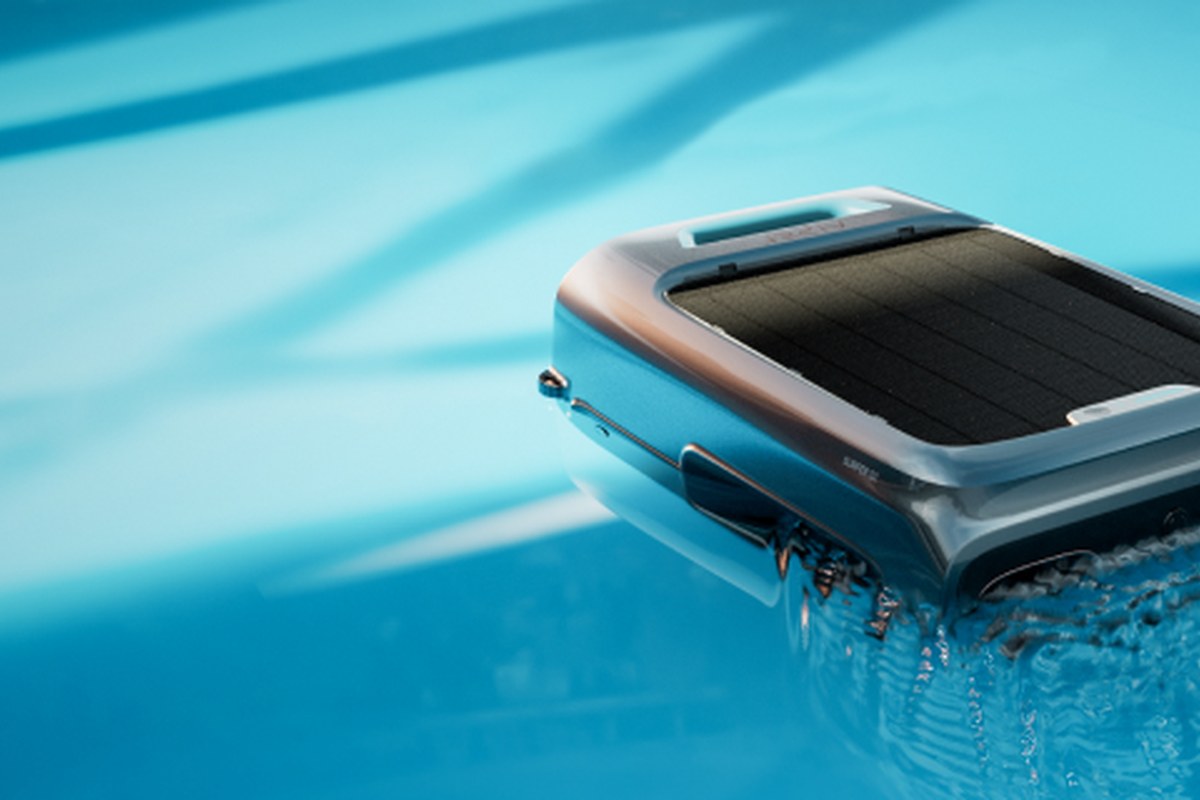
The Surfer S2, now presented as EcoSurfer S2 on Aiper's page, targets leaves, insects and other material floating on the water. Its strongest argument is preventative: collecting debris while it is accessible at the surface can reduce the material that later needs vacuuming from the bottom. That does not make it a floor cleaner or a substitute for pool circulation. The current published feature set includes solar charging, an enclosed four-litre basket, app control and a chlorine-tablet compartment. Naming and regional revisions should be checked carefully, especially when an older Surfer S2 review is used to evaluate the current EcoSurfer listing. The review here concerns the source's documented surface-cleaning proposition, with performance still to be verified in an actual pool.
SolarSeeker is useful only where sunlight exists
Aiper describes a system that moves toward sunlight when the battery needs charging. That is an interesting response to a real limitation of solar skimmers: a robot can spend time in shade even when part of the pool is sunny. The practical questions are how reliably it finds a productive location and how much cleaning time is sacrificed while charging. A pool under a dense canopy presents a different problem because there may be no useful charging spot to find. Map the sun across the water during the months you actually swim. The advertised battery endurance is not a reason to ignore consecutive cloudy days, seasonal shadows or the supplementary charging routine. Energy availability is part of pool compatibility.
The basket and DebrisGuard idea
An enclosed pull-out basket offers a different maintenance experience from lifting an open tray. Aiper's DebrisGuard baffle is intended to keep collected material from spilling out when the robot docks or reverses. Those are exactly the moments worth observing during a trial. A skimmer that captures a leaf and then releases it has not completed the job. Test a mixture of leaves, small twigs and fine floating material rather than one easy debris type. The stated 150-micron filter and four-litre capacity describe different aspects of the system: particle retention and storage volume. Neither tells us independently how quickly a real basket will need rinsing. Access, drainage and the ability to remove packed material matter as much as nominal volume.

Optical sensors do not eliminate every trap
The source describes optical obstacle sensing, self-rescue and anti-stranding measures. These are reasonable design responses to a surface robot's environment, but pool geometry can still produce awkward situations. A projecting step, shallow shelf, floating cover or strong current near a fixed skimmer may require behaviour that a simple wall-avoidance test never exercises. Watch the robot with the pool pump in normal operation and with the water level where it normally sits. If a machine only succeeds when the water level is artificially adjusted for a demonstration, that is a useful limitation to discover before purchase. Clear toys and loose equipment from the route and do not assume another robot's cable will be recognised as an ordinary obstacle.
Connected control should save a walk
A surface robot is a plausible candidate for phone control because its radio remains above the water more often than a submerged cleaner's. The value is practical: changing a schedule, checking status or bringing the machine to a convenient edge. Confirm wireless coverage at the pool itself and test what still works without internet access. A complicated account setup is tolerable if it subsequently saves effort; it is less attractive if the owner must repeatedly reconnect the device. Consider how another member of the household will empty or stop it. Basic operation should be understood by whoever looks after the pool, rather than residing entirely on one person's phone. No independent security audit was conducted for this review.
The chlorine compartment deserves separate judgment
Aiper includes a compartment for three-inch chlorine tablets and adjustable flow. That may reduce the number of objects floating in the pool, but it introduces a chemical-dosing function that should not be accepted casually as an automatic guarantee of correct water conditions. The amount released depends on operating conditions and the product being used. Continue the pool's established testing routine and follow the equipment and chemical instructions. Do not mix incompatible products or assume any tablet of approximately the right size is approved. Some owners may prefer to use the machine solely as a skimmer and keep dosing in a familiar system. That is a sensible separation when the main reason for buying the robot is debris collection.
Day-to-day care and outdoor exposure
A surface skimmer is exposed to sunlight, splash, chemicals and debris for long periods. Clean the panel and accessible sensors gently as directed and inspect the moving collection components for trapped stems or hair. Empty the basket before it becomes densely packed, particularly during leaf fall. The manufacturer's description of a long-running robot should not turn maintenance into an occasional afterthought. Remove it before swimming and follow storage instructions when the pool closes. Ask how charging components and batteries are serviced and whether a damaged basket can be ordered separately in your market. A clean panel, clear intake and unobstructed route are ordinary operating requirements, not evidence of a disappointing level of automation.
How to decide between skimmers
The Betta SE Plus emphasises a relatively simple solar-and-adapter approach with a handheld remote, while iSkim Ultra adds a much larger basket and more elaborate perimeter hardware. The S2's case rests on its app, enclosed basket, sunlight-seeking feature and integrated dosing option. Which one is preferable depends on the pool's debris load, available sun, wireless coverage and the owner's willingness to maintain accessories. A large basket may matter more than scheduling under a heavily shedding tree. Straightforward remote control may matter more than an app for a less technical household. If the pool's fixed skimmer already collects floating material effectively, spending on a better submerged cleaner could have greater impact than adding another surface machine.
The evidence still needed
Our research verdict is that the current Surfer S2 proposition is coherent for a sunny, debris-prone pool whose owner values connected control. It is less compelling for a shaded pool or a buyer whose primary problem is settled sand. We have not verified solar balance, escape behaviour, basket retention or dosing performance. A useful owner trial would count interventions across ordinary windy and calm days, record charging assistance and compare how much floating debris remains at the same time each evening. It should include the effort of emptying and rinsing the basket. Those observations would establish whether the added intelligence saves work in that pool, rather than merely adding interesting options to an otherwise familiar skimming task.
Sources & further reading.
These are the sources behind this research review. Manufacturer claims are not independent performance measurements. Community accounts, when cited, describe individual experiences.
- Aiper Surfer S2 — official product information ↗manufacturer
Documentation reviewed: 9 October 2026. Product software and regional bundles can change. Corrections and editorial disclosures.