An editorial assessment of documented capabilities and ownership trade-offs. This is not a hands-on test result or a measurement of reliability.
Features & capability 30%8.0
Fit adjustment and personalised processing are a substantial documented toolkit.
Compatibility & connectivity 20%7.4
Broad Apple and Android compatibility is useful; family-name assumptions require caution.
Ownership & upkeep 20%6.7
Small batteries, charging contacts and fitting-part completeness are significant used-purchase considerations.
Setup & everyday use 15%7.8
Touch volume and app fit checking help, although finding the correct combination takes time.
Documentation & support clarity 15%8.1
Original launch specifications clearly describe the fit kit and charging arrangement.
Compare scores within the same product category. Small decimal differences should not override your needs or the evidence limits.
How the Standpoint Score works
We score five aspects of the documented product on a 0–10 scale, then calculate a weighted total:
- Features & capability30% of the total
- Compatibility & connectivity20% of the total
- Ownership & upkeep20% of the total
- Setup & everyday use15% of the total
- Documentation & support clarity15% of the total
This product’s 7.6/10 is a provisional research assessment. It does not claim measured performance, tested reliability or a verified customer satisfaction rate. Compare it with products in the same category, and read each criterion’s reasoning above.
Read the full rubric and score bands ↗The ownership case.
A sensible candidate when the full fit kit is present and an extended trial establishes comfortable stability, dependable charging and sufficient battery reserve.
Reasons to consider it
- Separate tip and stability-band sizing
- CustomTune calibration with app fit checking
- Touch volume control on the earbuds
Go in knowing
- Used sets may lack essential fitting parts
- Wireless case charging requires the separate compatible accessory
- Three ageing batteries need more than a brief demonstration
The specification sheet.
Published specifications from the linked sources. Configurations and availability can differ by country.
- Introduced
- 2022
- Bluetooth
- 5.3
- Fit kit
- Three tip sizes and three stability-band sizes
- Resistance
- IPX4 earbuds
- Battery claim
- Up to 6 hours; case supplies three additional charges
- Case charging
- USB-C; optional wireless charging cover is separate
An older earbud built around fit
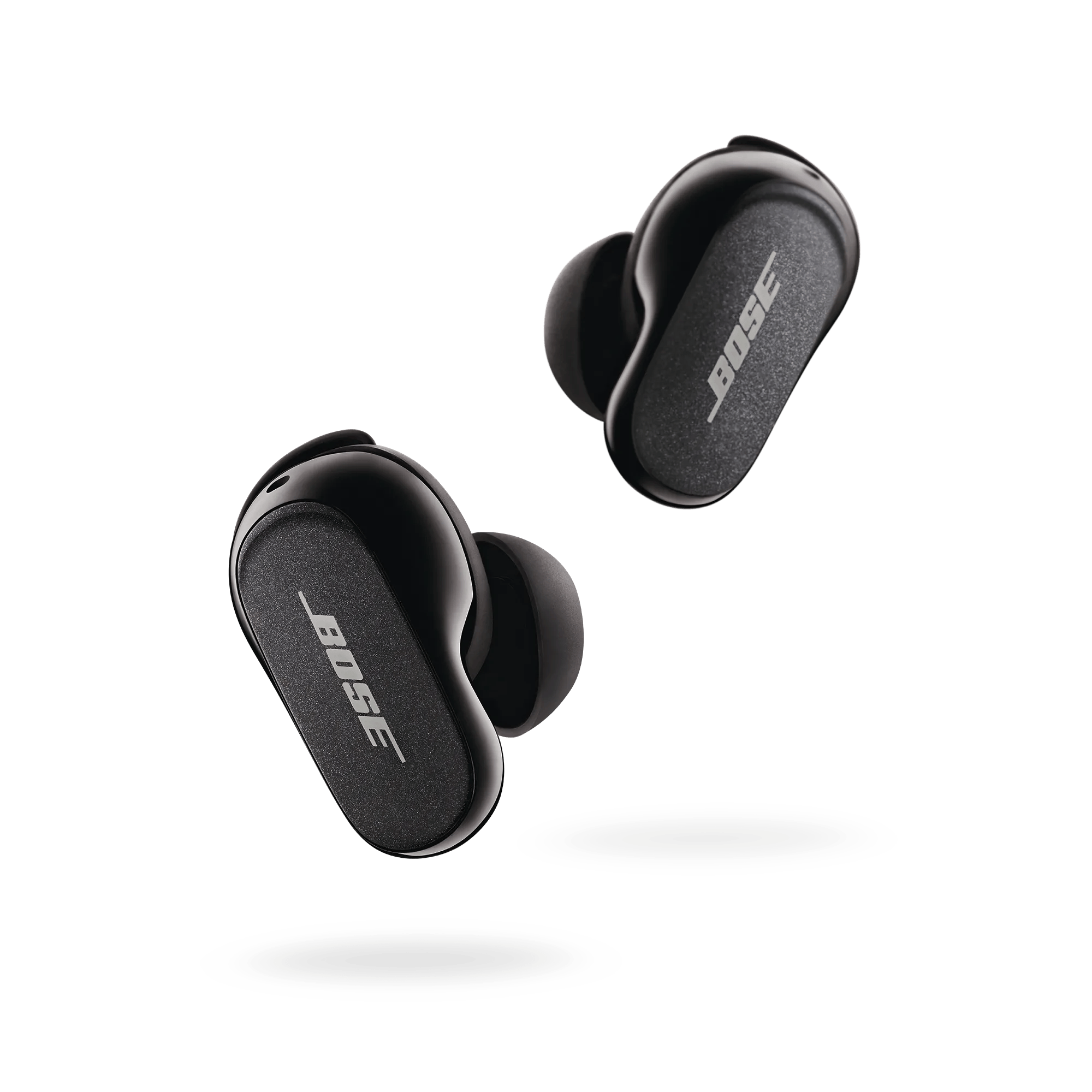
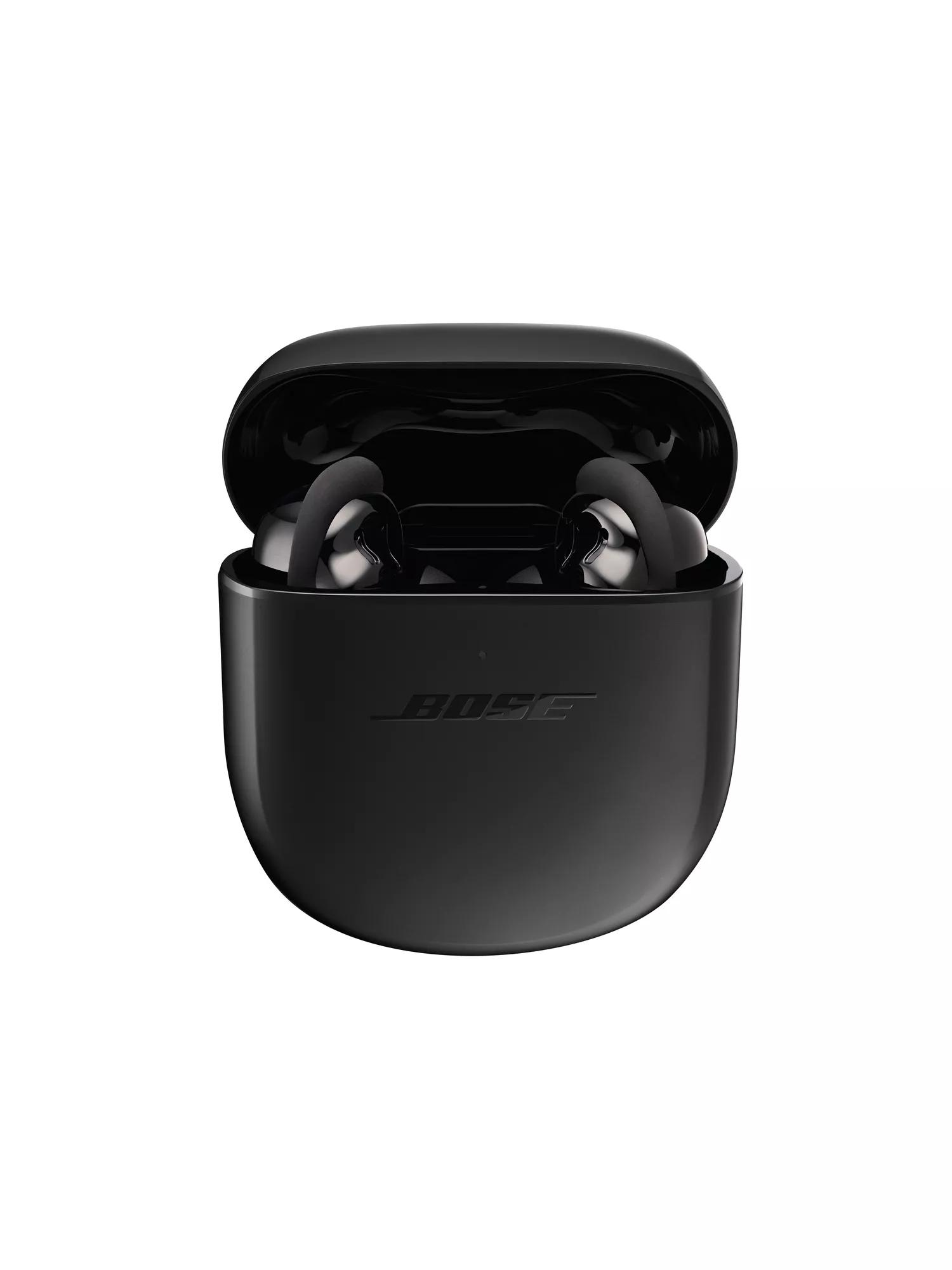
QuietComfort Earbuds II are most interesting for the way they separate the ear-canal seal from the part that helps hold the body in place. That gives a buyer more fitting choices than a design with one integrated piece, but it also means a used set is incomplete in a meaningful way if several sizes are missing. Before comparing prices, establish which tips and stability bands come with the pair and whether replacements are available through an appropriate local source.
Bose introduced this generation in 2022. It should not be confused with the original QuietComfort Earbuds, the later Ultra models or other products that reuse the QuietComfort name. The charging case and the exact model identification matter. A seller may describe all of them as Bose noise-cancelling earbuds, yet the controls, fit parts and software features are not interchangeable. This review assesses the Earbuds II documentation and the decisions facing an owner today, without claiming a hands-on comparison of cancellation strength.
Two fitting adjustments solve different problems
The documented fit kit contains three tip sizes and three stability-band sizes. The tip is intended to establish the acoustic seal; the band supports the body against the outer ear. Treat those as separate adjustments. If an earbud slips, immediately choosing a larger tip may create unnecessary pressure when the support band is the part that needs attention. Conversely, a secure-feeling body does not prove that the canal seal is adequate for consistent sound.
Try different combinations on the left and right rather than demanding symmetry. Human ears need not accept the same arrangement, and there is no practical advantage in forcing identical sizes if one side is uncomfortable. Use the app's fit check as an additional signal, then wear the pair while speaking and moving normally. A brief successful check cannot reveal whether a band becomes irritating after an hour. The value of this system is its adjustability, which requires time and a complete set of fitting parts to exploit.
CustomTune and the limits of calibration
CustomTune uses a calibration tone and microphones to inform Bose's processing. The useful implication is that the product is designed to account for aspects of the individual fit rather than relying solely on a fixed setting. It is not a substitute for a seal that remains stable when you move. If sound changes significantly after an earbud shifts, start with its physical position and fitting parts before assuming an equaliser adjustment is the solution.
Evaluate familiar material at a comfortable level before making app changes. A recording with a steady voice and a clear bass line can make inconsistent left-right fitting easier to notice, but it does not constitute a laboratory test. Our review does not convert the manufacturer's calibration description into a claim of superior fidelity. For a purchase decision, the important question is whether the system is comfortable and repeatable for you. Repeatedly readjusting the buds during ordinary use undermines the benefit of sophisticated processing that assumes they stay in place.
Aware mode has a specific role
Bose describes Aware mode with ActiveSense as a way of presenting the surroundings while responding to louder interruptions. That can be useful during a conversation or in a shared workspace, but it is still an electronically managed version of the outside world. Compare it with simply removing the earbuds. The result you prefer may depend on whether you are speaking, listening to a colleague or moving between rooms.
Do not turn an awareness feature into a promise that the earbuds will make every activity appropriate. If a task requires uninterrupted attention to environmental sound, removing them is the clearest way to eliminate their effect on that sound. For everyday convenience, try the mode at your normal playback level rather than with music paused. The interaction between the content and the returned surroundings determines whether you can follow speech comfortably. No published description can settle that balance for every listener, room and volume setting.
Touch controls and device expectations
The Earbuds II provide touch controls on both sides, including a swipe for volume. This reduces the need to retrieve a phone, which is useful when clothing or a bag makes it awkward to reach. It also creates a surface you may touch while adjusting the fit. During a trial, deliberately reseat each earbud and notice whether that action triggers an unintended command. A control system can be capable on paper yet frustrating if it conflicts with the way your ears need the product positioned.
Bluetooth 5.3 and support for Apple and Android devices establish broad wireless compatibility. They do not establish every advanced behaviour a buyer might expect from newer Bose products. Check the present firmware and exact model documentation for device switching and any special codec requirement. If the earbuds will alternate between a personal phone and a work computer, demonstrate that routine before purchase. Avoid paying for a feature that appears only in a seller's description of the wider QuietComfort family.
The case is part of the purchase
Bose's original battery claims are up to six hours for the earbuds and three additional charges from the case. Those figures describe the intended system when new; they are not a health report on three ageing batteries. Test both buds and watch for a consistent imbalance after ordinary playback. One side reaching empty substantially earlier can dominate the ownership experience even if the other side and case still hold useful capacity.
The original case charges through USB-C. Bose later offered an optional wireless charging cover, so wireless charging should not be assumed simply because a listing mentions it. Identify whether that separate accessory is present and works. Inspect the charging contacts and make sure each bud settles into its intended position without repeated pressure. A case that looks clean outside may still have intermittent contact inside. Reliable docking matters because charging is something most owners expect to happen without watching or rearranging the earbuds each time.

Used condition goes beyond cleanliness
The documented IPX4 rating concerns resistance to splashes under the specified conditions, not permission to immerse the product or assume that an older seal is unchanged. Sweat, skin oils and debris can accumulate around fitting pieces and microphone openings. Inspect these areas carefully and follow Bose's care guidance rather than trying aggressive cleaning methods. A physically tidy exterior is only one part of establishing whether the pair is suitable for continued use.
Budget for fresh personal-contact parts when the history is uncertain. That is also an opportunity to restore the full range of sizes, although compatible replacements must fit this exact generation. Confirm that the app recognises both earbuds and that normal charging, playback and calls work before completing a private sale. For Canadian or US buyers considering an imported pair, ask which service channel will accept the product and what proof of purchase is needed. A low asking price becomes less attractive when every replacement question is unresolved.
The right reason to choose this generation
The Earbuds II remain a coherent option for someone attracted to independent tip and stability adjustments, active noise control and accessible volume gestures. Their case and fit system deserve as much attention as the electronics because those are the parts the owner handles repeatedly. A healthy, complete pair can be more appealing than a newer model whose shape never settles comfortably, but that conclusion has to come from your fit trial rather than from a generation label.
Our provisional score recognises the documented flexibility while reserving judgment on measured sound, cancellation and long-term battery condition. The buying decision should include an extended wear period, a realistic device-switching test and enough playback to reveal a weak earbud. If those checks are impossible and the seller cannot establish the condition, the uncertainty should be reflected in what you are willing to pay. These are intimate, battery-dependent products; a complete fitting kit and a meaningful return policy have substantial practical value.
Sources & further reading.
These are the sources behind this research review. Manufacturer claims are not independent performance measurements. Community accounts, when cited, describe individual experiences.
- Manufacturer launch documentation ↗manufacturer
- Manufacturer product and support information ↗manufacturer
Documentation reviewed: 9 October 2026. Product software and regional bundles can change. Corrections and editorial disclosures.