Not tested. This is a research score for the documented features, compatibility and ownership trade-offs discussed in this review, not a performance measurement.
Features & capability 30%8.9
First 8K/60fps 360 video, strong SuperNight 2.0 low-light results across three outlets and user-replaceable lenses, held back by soft flattened footage.
Compatibility & connectivity 20%8.0
NFC pairing, direct DJI Mic support and shared Osmo Action batteries help, but OSV files need DJI software and there's no official US sale.
Ownership & upkeep 20%8.0
Cheap $28 to $36 lens kits and 105GB built-in storage keep costs low; scarce dive cases and 8K/60 overheating need planning.
Setup & everyday use 15%7.8
Tap-to-pair and gesture or voice starts are handy, but Mimo export crashes, online activation and 8K editing loads add friction.
Documentation & support clarity 15%7.9
DJI's footnotes spell out test conditions for battery and dynamic range claims, but Canadian warranty length isn't on the product page.
Compare scores within the same product category. Small decimal differences should not override your needs or the evidence limits.
How the Standpoint Score works
We score five aspects of the documented product on a 0–10 scale, then calculate a weighted total:
- Features & capability30% of the total
- Compatibility & connectivity20% of the total
- Ownership & upkeep20% of the total
- Setup & everyday use15% of the total
- Documentation & support clarity15% of the total
This product’s 8.2/10 is an editorial research assessment. It does not claim measured performance, tested reliability or a verified customer satisfaction rate. Compare it with products in the same category, and read each criterion’s reasoning above.
Read the full rubric and score bands ↗From a tech standpoint.
The Osmo 360 II is the best-value flagship 360 camera you can buy in Canada right now. At $799.99 it undercuts the Insta360 X6 by $140, adds user-replaceable lenses, and earns the strongest night-footage praise in this group from Engadget, TechRadar and SlashGear. The trade-offs are real: 8K at 60fps can overheat in warm, still air, the footage is soft once you flatten it to regular video, and DJI's editing apps still trail Insta360's. Buy it if you'll shoot at night or worry about smashing a lens. Pick the X6 if you want the camera to do the editing for you.
Reasons to consider it
- Swappable lenses: a scratched or cracked lens is now a roughly $28 to $36 fix you can do yourself in minutes, instead of a trip back to DJI.
- Night footage: Engadget, TechRadar and SlashGear all praise SuperNight 2.0, and the two outlets that compared it with the GoPro Max 2 side with DJI after dark.
- Price: $799.99 at Best Buy Canada is $140 below the Insta360 X6 Standard bundle at the same store.
- Storage: 105GB built in is more than double the X6's 47GB, per Engadget, so a forgotten microSD card doesn't end your day.
Go in knowing
- 8K/60fps can overheat: TechRadar got about 19 minutes indoors with no airflow before the camera shut down to cool off.
- Flattened video looks soft: Engadget's resolution charts put the centre between 1080p and 4K and the edges near 720p.
- Editing apps are the weak spot: Engadget rates DJI Studio behind Insta360's software, and owners on Reddit report Mimo crashing on longer exports.
- Not officially sold in the US, which matters if you want warranty help while wintering in Florida.
Affiliate link. As an Amazon Associate, Tech Standpoint earns from qualifying purchases. It never changes our verdict or score. Disclosure
The specification sheet.
Published specifications from the linked sources. Configurations and availability can differ by country.
- Canadian price (Oct 13, 2026)
- Standard Combo $799.99 at Best Buy Canada, $799 at Amazon.ca (with spare battery); Adventure Combo $949.99 at Best Buy Canada, $949 at Amazon.ca
- Sensors and lenses
- Two 1/1.1-inch square CMOS sensors, f/1.9 fisheye lenses, user-replaceable
- Video
- 8K 360° up to 60fps; 4K/240fps 360° slow motion; single-lens 4K up to 120fps; 10-bit, D-Log M, HLG
- Photos
- 120MP 360° panoramas with HDR; 30.72MP single-lens
- Storage
- 128GB built in (105GB usable) plus microSD up to 1TB
- Battery
- 2,150 mAh; DJI rates 100 minutes of 8K/30fps 360° recording
- Water and cold
- Waterproof to 10 m without a case, 50 m in the dive case; IP68; rated -20°C to 45°C
- Size and weight
- 61 x 36.3 x 81 mm, 183 g
- Connectivity
- Wi-Fi 6, Bluetooth 5.4, NFC tap-to-pair, USB-C; pairs directly with DJI wireless mics
- Max bitrate
- 220 Mbps for video
The 360 camera Americans can't buy is $140 cheaper than Insta360's in Canada
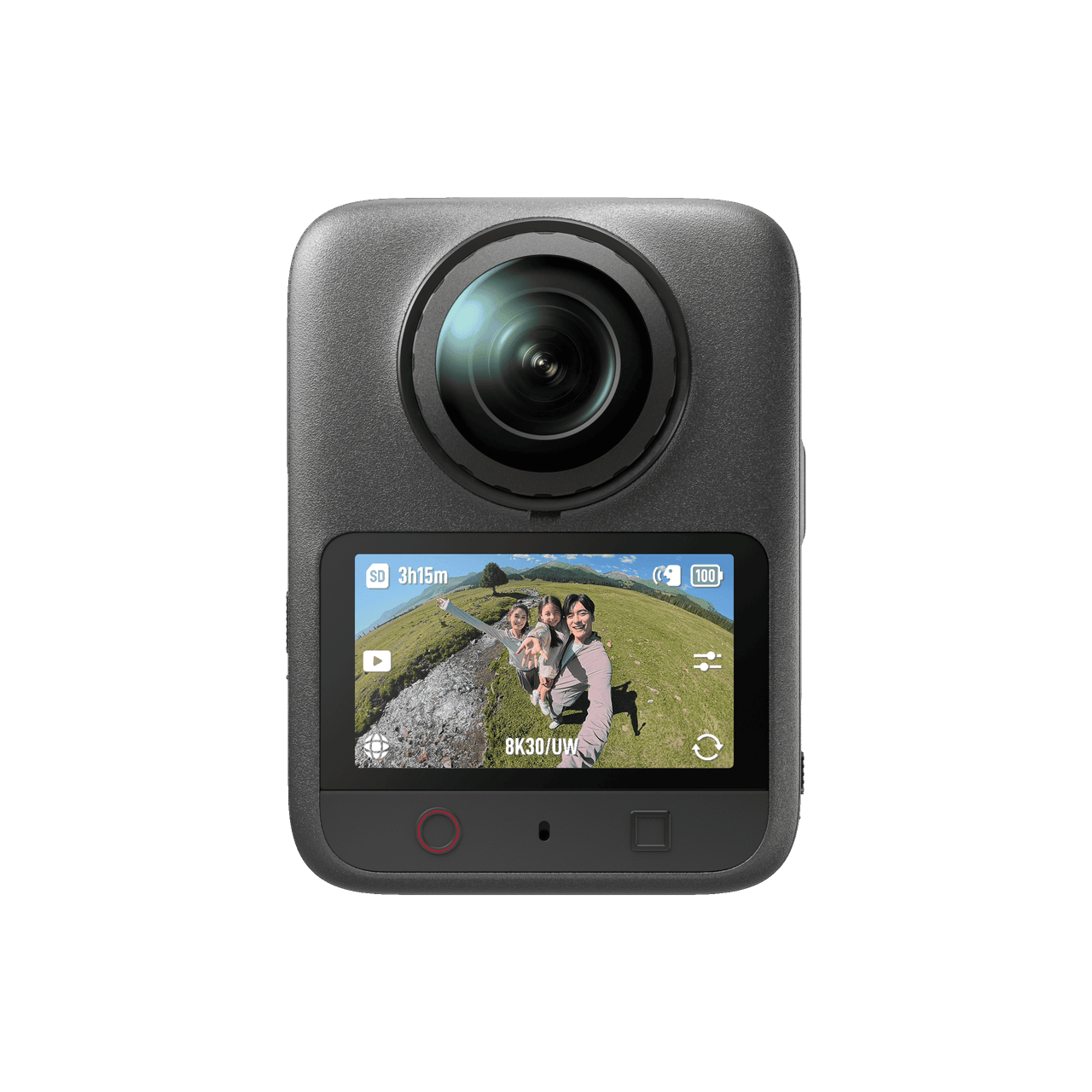
Here's the odd part. The best-value flagship 360 camera of the fall is one most Americans can't buy at a normal store, and it's sitting on the shelf at Best Buy Canada for $799.99. That's $140 less than the Insta360 X6 Standard bundle at the same retailer on October 13, 2026. The DJI Osmo 360 II is a pocket-sized block with a fisheye lens on each side. It films everything around you at once, then lets you choose the angle later on your phone or computer.
Amazon.ca had the Standard Combo at $799, bundled with a spare battery, and the Adventure Combo at $949, within a dollar of Best Buy's $949.99. DJI's own Canadian store was also taking orders for Ontario delivery, though it listed prices in US dollars on October 13. South of the border it's a different story: Engadget, TechRadar and SlashGear each report DJI hasn't launched it in the US, so buyers there are stuck with grey-market sellers.
So the question for a Canadian is simple. Is this the 360 camera to buy over the pricier X6 or a heavily discounted GoPro Max 2? The answer depends on two things: whether you shoot at night, and how much you hate editing. Start with what DJI actually changed.
Same body, same sensor, and lenses you can finally swap yourself
From the outside, not much. DJI kept the 61 x 36.3 x 81 mm body, the 183 g weight and the pair of 1/1.1-inch square sensors. TechRadar suspects the sensor is physically identical to last year's, which means most image gains come from a faster processor and new processing. The list of upgrades is still decent: 8K at 60fps instead of 50, a claimed 14.5 stops of dynamic range instead of 13.5, a new SuperNight 2.0 low-light mode, 4K/240fps slow motion, 16K timelapses, NFC tap-to-pair and a slightly bigger 2,150 mAh battery.
The change that matters most is the lenses. On the original, a cracked lens meant shipping the camera off to DJI. Now you unscrew it. Engadget swapped one in under five minutes with DJI's kit, which includes the removal tool, a blower, a suction cup and fresh gaskets. Best Buy Canada lists a replacement kit at $35.99, and Amazon.ca had the single-lens kit at $28. On a camera where both lenses bulge out like eyeballs, that's real peace of mind for anyone riding trails or skiing trees.
Who shouldn't upgrade? If you own the first Osmo 360 and your lenses are fine, SlashGear suggests waiting a generation. Owners comparing both cameras in r/djiosmo360 mostly describe modest gains: a higher top bitrate (220 versus 170 Mbps), a touch more sharpness and better white balance under artificial light. Where the new model clearly pulls ahead is after dark.
SuperNight 2.0 is the reason to pay more than a GoPro
DJI says SuperNight 2.0 pairs the f/1.9 lenses with a new AI noise-reduction system so it can use faster shutter speeds at night. That matters because blur, not just noise, ruins most 360 night footage. Engadget put the claim through a night ride on Paris streets with the camera on the handlebars. Its best results came from SuperNight 2.0 combined with an Anti-motion Blur setting, and it says the waxy, plastic look the first model gave people's faces is mostly gone.
SlashGear walked downtown Vancouver in the middle of the night and came back impressed with how noise stayed under control and how highlights and shadows held up. Its one complaint: the camera tends to lift shadows brighter than your eyes see them. TechRadar found SuperNight far cleaner than on the original and says the GoPro Max 2 struggles once the sun sets. One catch from TechRadar: you can't use D-Log M, DJI's flat colour profile for grading, while SuperNight is on.
In real life, this is the difference between usable and unusable footage of a December walk through a Christmas market, or the last hour of a fall ride when the sun drops at 6 p.m. Both TechRadar and SlashGear, the outlets that compared it with the Max 2, side with DJI at night. If you shoot after dark even a few times a year, that alone covers the price gap. Night footage that looks clean raises a fair question, though: what's the catch with the big 8K/60 headline?
8K at 60fps is a first, and it comes with a heat timer
TechRadar calls the Osmo 360 II the first 360 camera to record native 8K at 60fps; the X6 tops out at 8K/50. Sixty frames looks smoother on phones and laptops and drops straight into a timeline alongside phone footage without frame-rate conversion. SlashGear rated its 8K/60 footage among the best it's seen from a 360 camera, but warns that playing those files back on a PC needs a fast drive.
Heat is the limit. TechRadar's camera ran about 19 minutes at 8K/60 indoors at room temperature, with no breeze, before shutting down to cool off, and the camera warns you when you pick that mode. Expert Reviews got roughly half an hour of continuous top-quality recording before overheating. SlashGear's experience shows how much the weather matters: more than two hours of mostly 8K/60 in cold wind on a Zodiac ride was fine, but in a hot seaplane cabin most clips showed up as invalid files on the camera, though they played normally in the Mimo app and on a PC.
On a ski hill or a bike in October, you'll likely never hit the wall. Filming a long indoor event or sitting in a parked car in July is another story. Drop to 8K/30 for long takes: DJI rates 100 minutes there, TechRadar's battery drain matched that almost exactly, and Engadget got about 105 minutes. Engadget also clocked a full recharge in 39 minutes, down from 91 on the original. Treat 8K/60 as a highlight-reel mode. Then ask how sharp that 8K really looks.
Engadget's resolution chart shows the ceiling every 360 camera hits
8K sounds razor sharp, but those pixels are spread around a full sphere. When you reframe to a normal flat video, you're using a small slice. Engadget measured this with resolution charts and rated the centre of the frame somewhere between 1080p and 4K, with the edges closer to 720p. It's clearly softer than DJI's own Osmo Action 6 Pro, a regular action camera, though Engadget says it's very close to the Insta360 X6.
Stitching, the job of blending the two halves into one image, is mostly solid. SlashGear says the seam is usually invisible with occasional flaws. Engadget saw some artifacts at certain angles but fewer than on the X6, and TechRadar calls stitching and selfie-stick removal excellent. Expert Reviews gives a useful rule: keep subjects about 75 cm from the camera or the seam can show. Switch to single-lens mode for sharper close-ups.
My take: buy a 360 camera for the angles, not for pixel peeping. If you want the crispest possible clip of your kid's first ski run, a regular action cam such as the GoPro Hero13 Black will look sharper. If you want to film the run once and pick the best angle afterward, this is the trade you accept. Picking that angle is where the next headache lives.
Reviewers split on DJI's editing apps, and owners lean negative
Every 360 clip has to pass through software before it looks like normal video. The camera records in OSV, DJI's own format, so you'll use the DJI Mimo phone app or DJI Studio on a computer. Engadget is the harshest: it calls Studio unintuitive, short on colour correction, effects and titles, and behind Insta360's software. DJI's new Reframe plugin for DaVinci Resolve helps, but you have to export to MP4 first, which Engadget says is a chore and costs some quality.
Other outlets are kinder. Expert Reviews liked Mimo's quick 360 workflow and its preset camera moves. SlashGear found desktop Studio efficient even with hours of 8K/60 footage, but called Mimo frustrating. TechRadar rated both apps dependable but wasn't impressed by Mimo's AI auto-edits, and Digital Camera World felt DJI's desktop software was less polished than Insta360's.
Owners add a sharper edge. In r/djiosmo360, several report Mimo crashing partway through exporting longer projects on Android, and others say DJI Studio started lagging or crashing after an update. In an r/Insta360 thread weighing the two cameras, the most upvoted advice for people who hate editing was to buy Insta360, though a few DJI owners argue desktop Studio is the more capable tool.
Plan for big files, too. Engadget moved 20GB, just 8.2 minutes of video, in about 32 seconds over USB-C to a fast drive. On a five-year-old laptop with a nearly full SSD, 8K editing will be painful. If you like tinkering, you'll manage. If you want a finished reel by bedtime, read the next section closely.
How the Canadian prices line up against Insta360 and GoPro
The Insta360 X6 is the main rival at $939.99 for the Standard bundle at Best Buy Canada and $939 at Amazon.ca, or $1,039.99 for the Essentials bundle. Per Engadget it lasts longer, about 140 minutes at 8K/30, and charges a bit faster. TechRadar notes it's waterproof to 20 m without a case, double DJI's 10 m. Its edge is software: easier AI editing that does more of the work. DJI counters with more storage, the 8K/60 mode and the lower price.
Last year's Insta360 X5 was $624.99 at both Best Buy Canada and Amazon.ca on October 13, which makes it the middle ground if you want Insta360's apps for less. The GoPro Max 2 is the budget pick: Best Buy Canada's $429.99 sale price was sold out, and Amazon.ca had a Max 2 accessory bundle at $499.99. TechRadar and SlashGear both rate its daylight footage highly but its night footage well behind DJI's, and SlashGear prefers GoPro's built-in mounting fingers. The original Osmo 360 Essential Combo was $529 at Amazon.ca.
My ranking: the Osmo 360 II for value and night shooting, the X6 if editing is the part you dread, and the Max 2 on sale if you only film sunny days. So what does owning DJI's camera look like after the box is open?
Living with it in Canada: cheap lenses, shared batteries, scarce dive cases
Running costs are low. Lens kits run about $28 to $36. DJI says the camera takes Osmo Action Extreme and Extreme Plus batteries too, so if you already own a recent DJI action camera, your spares work. The 105GB of built-in storage means a microSD card is optional, and the camera takes cards up to 1TB. DJI rates it down to -20°C, which covers most Canadian ski days. DJI's Canadian store lists DJI Care Refresh accident plans at US$46 for one year and US$78 for two, and promises up to 30-day returns.
Owner threads raise two things worth planning for. Several posts in r/djiosmo360 complain the Osmo 360 dive case keeps going out of stock, including on DJI's Canadian site, so if you're booking a winter snorkelling trip, order the Diving Combo or case early. Original Osmo 360 owners there also grumble that a promised firmware update never arrived on schedule, which is a reasonable thing to weigh when you're counting on fixes after purchase.
Two smaller notes. SlashGear dislikes that the camera has to be activated online through an account before first use. And if you spend winters in Florida or Arizona, remember that DJI isn't selling this model in the US. Nothing in the reporting says a Canadian unit stops working there, but plan on handling any repair back home.
Buy it for night rides and travel; skip it if editing makes you groan
Buy the Osmo 360 II if you're a Canadian picking your first serious 360 camera and you'll use it on bikes, ski hills, road trips or city walks after dark. It's also the obvious pick if you already own DJI mics or Osmo Action batteries, or if you've cracked a lens on the original and paid for it. If you shoot all day, the $949.99 Adventure Combo makes sense: TechRadar notes it adds two extra batteries, a three-battery charging case and a 1.2 m selfie stick.
Skip it if you own a working original Osmo 360, if you want the camera to cut your highlight reel for you (get the X6), or if you only shoot in daylight and want to spend under $500 (watch for the GoPro Max 2 on sale). And if razor-sharp footage matters more than choosing angles later, a regular action camera will serve you better than any 360 model.
Questions before checkout.
Is the Osmo 360 II worth upgrading from the original Osmo 360?
Usually not, unless you've damaged a lens or shoot a lot at night. Reviewers and owners describe the image gains as modest. The big wins are user-replaceable lenses and a cleaner SuperNight mode, and SlashGear suggests most original owners wait a generation.
Can I buy the DJI Osmo 360 II in the United States?
Not through official channels. Engadget, TechRadar and SlashGear all report DJI hasn't launched it in the US. In Canada it's sold at Best Buy Canada, Amazon.ca and DJI's own store, so Canadians can buy it normally with local returns.
Should I get the Osmo 360 II or the Insta360 X6?
Get the Osmo 360 II if price and night footage matter most: it's $140 cheaper at Best Buy Canada and reviewers praise its low-light video. Get the X6 if you want longer battery life, 20 m case-free waterproofing and easier AI editing.
Will it handle a Canadian winter?
DJI rates it from -20°C to 45°C, so most ski days and winter walks are covered. Cold actually helps with the 8K/60 overheating problem: SlashGear recorded for over two hours in cold wind without trouble. Batteries drain faster in the cold, so carry spares.
Do I need a powerful computer to edit the footage?
It helps a lot. Engadget's transfer test showed 8.2 minutes of video taking up about 20GB, and SlashGear warns 8K/60 playback needs a fast drive. You can edit on a phone with the DJI Mimo app, but owners report crashes on longer exports.
Does the Osmo 360 II work with DJI wireless mics?
Yes. Engadget says it connects directly to DJI's Mic 3, Mic 2 and Mic Mini series, which gives much clearer voice audio than the four built-in mics. SlashGear still rates the built-in audio better than the GoPro Max 2's.
Sources & further reading.
These are the sources behind this research review. Manufacturer claims are not independent performance measurements. Community accounts, when cited, describe individual experiences.
- DJI Store Canada: Osmo 360 II Standard Combo ↗manufacturer
- DJI Canada: Osmo 360 II specs ↗manufacturer
- Engadget: DJI Osmo 360 II review ↗independent testing
- TechRadar: DJI Osmo 360 II review ↗independent testing
- Expert Reviews: DJI Osmo 360 II review ↗independent review
- SlashGear: DJI Osmo 360 II review ↗independent review
- Digital Camera World: DJI Osmo 360 II hands-on review ↗independent review
- Best Buy Canada: DJI Osmo 360 II Standard Combo ↗retailer
- Best Buy Canada: DJI Osmo 360 II Adventure Combo ↗retailer
- r/djiosmo360: Osmo 360 vs Osmo 360 II comparison ↗Community discussion
- r/djiosmo360: DJI Mimo crashing during exports with Osmo 360 II ↗Community discussion
- r/djiosmo360: Dive case out of stock on Canadian website ↗Community discussion
- r/Insta360: First 360 camera, Insta360 X6 or DJI Osmo 360 2? ↗Community discussion
Product software and regional bundles can change. Corrections and editorial disclosures.
Affiliate link. As an Amazon Associate, Tech Standpoint earns from qualifying purchases. It never changes our verdict or score. Disclosure