Not tested. This is a research score for the documented features, compatibility and ownership trade-offs discussed in this review, not a performance measurement.
Features & capability 30%8.3
About 95% BT.2020 and up to 3,543 nits measured by outlets, a matte screen and 936 zones are strong, but real-content colour and out-of-box accuracy disappointed several reviewers.
Compatibility & connectivity 20%8.6
Four HDMI 2.1 ports at 4K 180Hz, Dolby Vision plus HDR10+, Wi-Fi 6E, and AirPlay cover nearly everything; Dolby Vision 2 support is unclear.
Ownership & upkeep 20%7.3
One-year Hisense Canada warranty, no stated software update term and a first-generation RGB backlight with no long-term track record; Costco's second year helps.
Setup & everyday use 15%7.6
Google TV is familiar and the sound is above average, but reviewers needed picture tweaks for accuracy and settings changes to reach the lowest input lag.
Documentation & support clarity 15%6.8
Hisense Canada's sheet is detailed on ports and dimensions but quotes 5,000 nits that no test supports, and speaker wattage differs between Hisense, Costco and reviewers.
Compare scores within the same product category. Small decimal differences should not override your needs or the evidence limits.
How the Standpoint Score works
We score five aspects of the documented product on a 0–10 scale, then calculate a weighted total:
- Features & capability30% of the total
- Compatibility & connectivity20% of the total
- Ownership & upkeep20% of the total
- Setup & everyday use15% of the total
- Documentation & support clarity15% of the total
This product’s 7.8/10 is an editorial research assessment. It does not claim measured performance, tested reliability or a verified customer satisfaction rate. Compare it with products in the same category, and read each criterion’s reasoning above.
Read the full rubric and score bands ↗From a tech standpoint.
The UR8 is a very good bright-room TV wearing a technology badge it hasn't fully earned yet. Lab results back up the wide colour range and strong HDR brightness, but TechRadar, What Hi-Fi and Digital Trends all found real content less vivid than the measurements suggest, and out-of-the-box accuracy is poor. At $1,899.99 it costs $600 more than Hisense's own U88QG and $100 more than the brighter TCL QM8L, and it sits $100 under two OLEDs that beat it in a dark room. Buy it at Costco's $1,697.99 or wait for a sale. This is a research review: Cameron hasn't used the UR8, and every observation here belongs to the outlet named.
Reasons to consider it
- Widest measured colour range of any LCD in its class: TechRadar and Tom's Guide both recorded about 95% of BT.2020, against roughly 90% for the TCL QM8L, so it has headroom for future HDR content.
- Bright enough for a room full of windows. Tom's Guide measured 3,542.7 nits in HDR on the 75-inch and 1,685.9 nits in the default SDR mode, about double the average of the rivals they compared.
- All four HDMI ports are full HDMI 2.1 with 4K at up to 180Hz, so a PS5, an Xbox, a gaming PC and a soundbar on eARC can all be plugged in without juggling.
- The matte Obsidian screen kept reflections down for Tom's Guide, What Hi-Fi and BGR, which matters more in a daytime living room than another few hundred nits.
Go in knowing
- The colour you paid for is hard to see. TechRadar, What Hi-Fi and Digital Trends each said real films and shows looked less bold than the test numbers suggest.
- Out-of-the-box accuracy is weak. TechRadar measured an SDR Delta-E of 7.9, Tom's Guide 4.80, and RTINGS describes a too-warm picture with a red tint that needs calibration to fix.
- It isn't the brightness leader at its price. TechRadar's 65-inch hit 2,097 nits in Filmmaker Mode while the cheaper TCL QM8L hit 3,719.
- Hisense Canada's own spec sheet quotes up to 5,000 nits, a figure no outlet has come close to, and retailers disagree with Hisense on speaker wattage.
Affiliate link. As an Amazon Associate, Tech Standpoint earns from qualifying purchases. It never changes our verdict or score. Disclosure
The specification sheet.
Published specifications from the linked sources. Configurations and availability can differ by country.
- Canadian price (Nov 20, 2026)
- 65-inch (65UR8SG): $1,899.99 at Best Buy Canada (regular price, sold by Best Buy); $1,697.99 at Costco.ca for members (showing out of stock online when checked). A Best Buy Marketplace seller lists the same TV at $2,277.99
- Sizes
- 55, 65, 75, 85 and 100 inches per Hisense Canada
- Panel and backlight
- 4K LCD with RGB Mini LED backlight, 936 local dimming zones on the 65-inch, Obsidian anti-reflection panel. What Hi-Fi lists the panel as VA
- Brightness and colour claims
- Up to 5,000 nits and up to 100% BT.2020 per Hisense Canada. Measured by outlets: 2,097 to 3,543 nits and about 95% BT.2020
- Refresh rate
- 180Hz native, VRR 48 to 180Hz, FreeSync Premium Pro, ALLM
- HDR formats
- Dolby Vision, Dolby Vision IQ, HDR10, HDR10+, HDR10+ Adaptive, HLG, IMAX Enhanced
- Inputs
- 4 HDMI 2.1 (eARC on HDMI 3), 1 USB 3.0, 1 USB 2.0, Ethernet, optical out
- Wireless and software
- Wi-Fi 6E, Bluetooth 5.4, Google TV, AirPlay and HomeKit, Alexa built in
- Sound
- 2.1.2 channel, 50W, Dolby Atmos, DTS Virtual:X, tuned by Devialet (per Hisense Canada)
- Weight, mount and warranty (65-inch)
- 23.4 kg with stand, VESA 400 x 300, 1 year warranty (all provinces except Quebec) per Hisense Canada
Hisense Canada's spec sheet says 5,000 nits. The best lab number so far is 3,543
The UR8 is the first RGB Mini LED TV sold at a normal TV price. The 65-inch 65UR8SG is $1,899.99 at Best Buy Canada today, and Costco.ca lists it to members at $1,697.99. A regular Mini LED TV shines blue or white LEDs through a quantum dot layer to make colour. This one uses separate red, green and blue LEDs in the backlight, and Hisense says that gets you up to 100% of the BT.2020 colour space with no quantum dot film at all.
The Canadian spec sheet also says "up to 5,000 nits". Nobody has measured that. Tom's Guide recorded 3,542.7 nits on a 75-inch set in Filmmaker Mode. TechRadar recorded 2,097 nits on a 65-inch in the same mode and 2,394 in Standard. Other outlets quote Hisense's claim for the 65-inch as 3,500 nits, so the Canadian figure looks like a best-case number, and it's not confirmed which size it applies to.
So the question for anyone with about $1,900 to spend is simple. Is RGB Mini LED a real step over a regular Mini LED like Hisense's own U88QG or TCL's QM8L, or over an OLED at the same money? Going by the published testing, it's a small step in the lab and a smaller one on the couch. Everything below comes from Hisense's documents and from named outlets; nothing here is first-hand.
What's new over last year's U8, and who should keep their current TV
Hisense slots the UR8 above its regular U7 and U8 Mini LED lines and below the flagship UR9, according to Tom's Guide. The headline change is the backlight. The 65-inch has 936 dimming zones of red, green and blue LEDs, plus what Hisense calls an Obsidian anti-reflection panel that it says cuts reflections to between 1.5% and 1.8%.
BGR notes two practical upgrades over the previous U8: the native refresh rate goes from 165Hz to 180Hz, and there are now four HDMI 2.1 ports where the old model had three HDMI ports in total. The sound system is a 2.1.2 layout tuned by Devialet. Tom's Guide also flagged that one retailer listing advertised a USB-C DisplayPort input the TV doesn't have, so don't count on one.
If you bought a Hisense U8 or a TCL QM8 in the last two years, skip this. Your TV is already about as bright, and the colour gain is the part reviewers struggled to see. Dolby Vision 2 isn't a reason to upgrade either: it's not on Hisense Canada's spec list, BGR says it's kept for the UR9, and Tom's Guide calls the UR8 upgradeable. Treat it as not confirmed.
It measures 95% of BT.2020. So why did three reviewers shrug at the colour?
On a meter, the RGB backlight does what Hisense says. TechRadar measured 95.1% of BT.2020 and Tom's Guide measured 95.04%. The TCL QM8L, a very good regular Mini LED, managed about 90% in both labs, and Samsung's QN80H managed 75% in TechRadar's. Tom's Guide says the UR8 beat every LCD in their comparison pool on all three colour gamuts they measure.
Then the outlets watched actual films. TechRadar called the colours natural but not as bold as hoped, and named colour as the area where the TV fell short of expectations. What Hi-Fi, testing the UK version, reported a surprising lack of colour vibrancy with real content. Digital Trends said a Samsung QN80H looked bolder in some scenes, despite its much narrower measured gamut. Tom's Guide was the happy one, praising skin tones and costume colours in Dolby Vision.
Part of the explanation is simple: almost nothing you can stream today is mastered to fill BT.2020, a point Tom's Guide makes directly. Part of it is accuracy. TechRadar's SDR Delta-E was 7.9 against 3.7 for the QM8L, and Tom's Guide's 4.80 ranked 25th of 26 TVs. RTINGS describes poor SDR accuracy with a too-warm image, a red tint in HDR, and some colour crosstalk where whites pick up the tint of nearby colours. That last one is specific to RGB backlights.
The fair read: the wide gamut is real, but today it's a spec for future content. You're paying for headroom, and you'll want a calibration or some time in the picture menus to get the colour right in the meantime.
Bright enough for any Canadian living room, but the TCL beside it is brighter
Forget the 5,000-nit line and look at the measurements. They're still strong. Tom's Guide's 75-inch reached 3,542.7 nits in HDR against a 1,928.6-nit average for the sets they compared it with. In the default picture mode with regular SDR content, it put out 1,685.9 nits, roughly double the rival average. BGR, without measuring, found it bright enough for a room with large windows.
The catch is the comparison. TechRadar's 65-inch hit 2,097 nits in Filmmaker Mode where the TCL QM8L hit 3,719, and full-screen brightness was nearly identical at 771 and 759 nits. Tom's Guide had the 75-inch QM8L slightly ahead too. So if raw HDR punch is what you're after, the regular Mini LED that costs $100 less wins.
The two labs' UR8 numbers are far apart, and they tested different sizes and regional models, so it's not confirmed how close a Canadian 65-inch gets to the higher figure. Either result is plenty for afternoon hockey with the blinds open.
Lights off, an OLED at the same price still looks better
Backlight control is one of the UR8's better traits. TechRadar praised it as excellent for an LED TV, with strong contrast and decent black levels. Digital Trends and BGR both said blooming, the halo around bright objects on black, is well controlled, though BGR could spot some in a very dark room. Tom's Guide thought it handled the dark scenes in Dune and Top Gun: Maverick very well.
But every outlet that compared it with an OLED gave the dark room to the OLED. Digital Trends said dark scenes can look slightly grey next to one. What Hi-Fi criticized black depth and said blacks turn greyer when there's light in the room, which is the usual trade with a matte screen. TechRadar's headline says it plainly: this isn't an OLED killer.
The matte screen is the flip side, and it's a real advantage by day. Tom's Guide, What Hi-Fi and BGR all found reflections well suppressed. If most of your viewing happens with lamps on or sun coming in, that matters more than perfect black. If you watch movies at night with the lights off, it doesn't.
Four full-speed HDMI ports and 180Hz, with one setting gamers need to know
Gaming is where the UR8 gets the fewest complaints. All four HDMI ports are HDMI 2.1 and take 4K at up to 180Hz, with VRR from 48 to 180Hz, FreeSync Premium Pro, ALLM, and both Dolby Vision and HDR10+ gaming. Consoles top out at 120Hz, so the extra headroom is for PC players. Tom's Guide lists up to 330Hz at 1080p.
Input lag is fine, not class-leading. Tom's Guide measured 12.0ms and TechRadar 11.7ms at 4K 60Hz, against about 9.5ms for the TCL QM8L. What Hi-Fi got 14.2ms and pointed out that the lowest figure needs Local Dimming switched off, which costs you contrast. TechRadar also said low lag takes some settings changes.
RTINGS calls it a solid gaming TV with some motion blur in fast games, and Digital Trends saw blur and lost texture in quick camera pans. For most people with a PS5 or Series X, this is a great gaming screen. Competitive PC players chasing the cleanest motion should look at OLED.
At $1,899.99 it's boxed in by a $1,299.99 Hisense and two $1,999.99 OLEDs
Here's the shelf it sits on at Best Buy Canada on November 20. Hisense's own 65-inch U88QG, the Canadian version of last year's U8, is $1,299.99 on sale from $1,699.99. The TCL 65QM8L is $1,799.99 on sale from $2,999.99, and the 65QM7L is $1,299.99. The 65-inch LG C6 and Samsung S90H OLEDs are both $1,999.99 on sale. The step-up Hisense 65UR9SG is $2,499.99. The UR8 isn't on sale at all.
Against the regular Mini LEDs, the UR8 gives you about five points more BT.2020 coverage, a matte screen and a fourth HDMI 2.1 port. The QM8L gives you more HDR brightness and better accuracy for $100 less. The U88QG wasn't in the comparisons read for this review, so how close it gets isn't confirmed, but a $600 gap is hard to justify on colour that reviewers had trouble seeing.
Against the OLEDs, it's a room question. The Samsung S90H, covered in a separate research review on this site, also has a matte screen and reached 1,689 nits in TechRadar's testing, with perfect blacks. The LG C6 adds Dolby Vision. For $100 more, either is the better movie TV. The UR8 is the better pick only if your room is very bright or you worry about leaving static content on an OLED for hours.
Living with it: a one-year warranty, a soundbar you may skip, and ads on the home screen
Hisense Canada lists a one-year warranty for all provinces except Quebec, where the terms differ. Costco.ca's listing adds a second year of warranty and says TVs can be returned within 90 days, which makes the cheaper Costco price the better deal twice over if you have a membership. Best Buy's return window wasn't confirmed for this review, so check it at checkout.
Sound is better than most TVs manage. Tom's Guide rated it well above average and comparable with the Samsung S90H's. TechRadar and Digital Trends liked the dialogue and bass but found the soundstage narrow, and BGR wanted more bass. The Canadian spec sheet says 50W, Costco's listing says 80W and TechRadar's says 70W, so the wattage isn't confirmed. A soundbar is optional here, not urgent.
The Canadian model runs Google TV, which Tom's Guide describes as leading with a large carousel of promoted content; an Apps Only Mode strips most of that back. BGR saw occasional lag in some submenus. Hisense's page doesn't say how many years of software updates the UR8 gets, so that's not confirmed. There are no long-term ownership patterns to report yet, and RGB backlights are too new for anyone to know how they age.
Buy it at Costco's price for a bright room. At $1,899.99, buy something else
Buy the UR8 if your TV lives in a sunny room, you game on more than two devices, and you can get it for around $1,700 or less. At that price the matte screen, four fast HDMI ports and strong brightness add up to a good deal, and the wide colour range is a free bonus that may pay off as content catches up.
Skip it at $1,899.99 if you mostly watch at night. The LG C6 or Samsung S90H at $1,999.99 will look better in the dark. And if you just want a very bright Mini LED for sports, the TCL 65QM8L at $1,799.99 measured brighter and more accurate, while Hisense's U88QG saves you $600.
US prices hint at where this is going. TechRadar says the 65-inch launched at US$1,999 and has already dropped to US$1,499 there. Canadian pricing hasn't followed yet. With Black Friday a week away, waiting costs you nothing.
The closest alternatives.
| Product | Standpoint Score | Best for | Price |
|---|---|---|---|
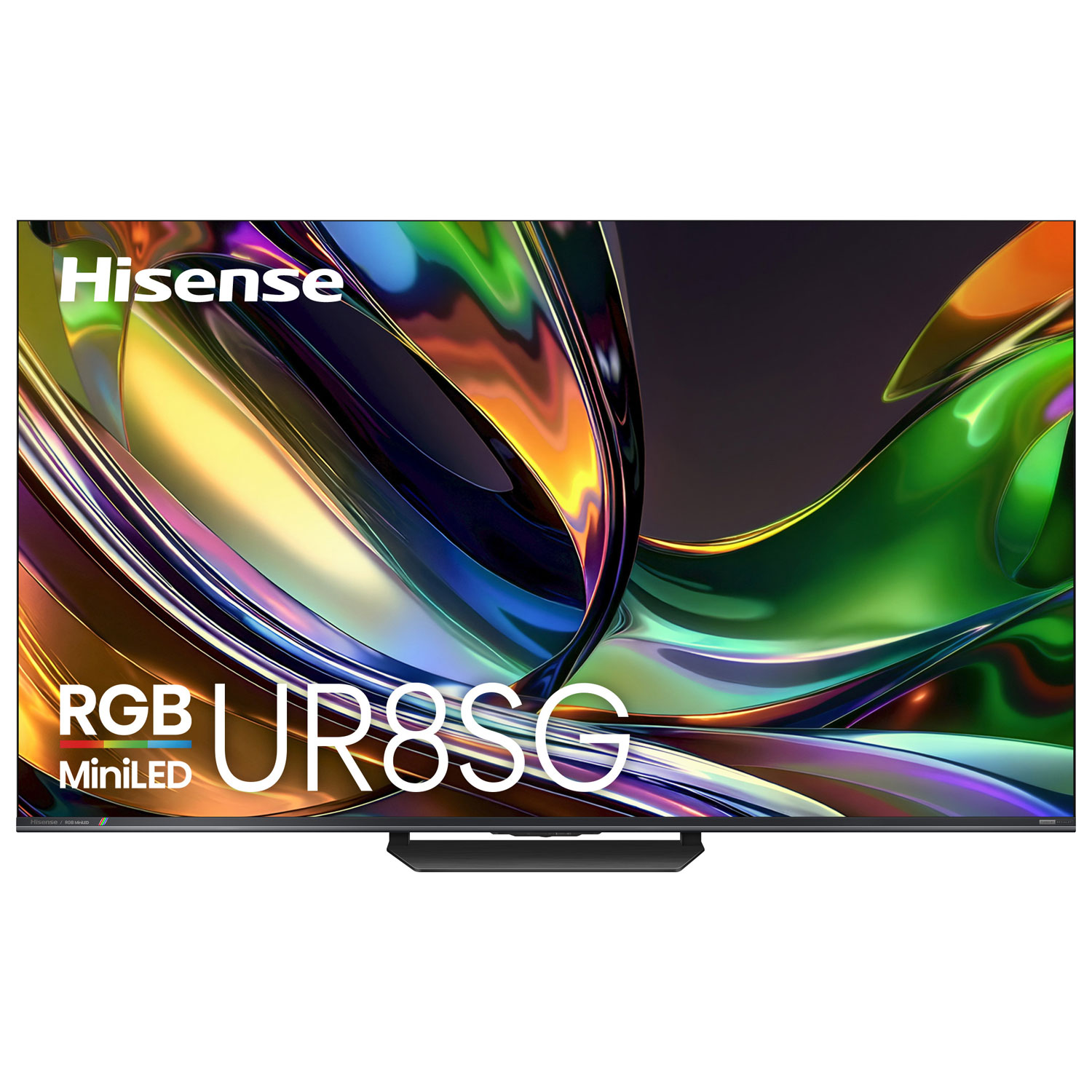
| Hisense UR8This review | 7.8Research | Bright living rooms, sports and console or PC gaming, bought at the Costco price or on sale rather than at $1,899.99. | Amazon.ca ↗ |
| Samsung S90H OLED | 8.1Research | Bright living rooms and gamers who want a 65-inch OLED around $2,000 that doesn't turn into a mirror every afternoon. | Amazon.ca ↗ |
| LG C5 OLED 65-inch | 8.3Research | A film and gaming household that can plan a suitable room, installation and source equipment. | Amazon.ca ↗ |
| Apple TV 4K (A15) | 8.3Research | A household that wants a dedicated viewing interface and specific, verified Apple integrations. | Amazon.ca ↗ |
Compare scores within a category: Tested means our own use, Research means documentation and attributed outside testing. Price links are affiliate links. As an Amazon Associate, Tech Standpoint earns from qualifying purchases. Disclosure
Questions before checkout.
Is the Hisense UR8 sold in Canada, and how much is it?
Yes. The Canadian model is the UR8SG, in 55, 65, 75, 85 and 100-inch sizes. On November 20, 2026 the 65-inch was $1,899.99 at Best Buy Canada and $1,697.99 at Costco.ca for members, though Costco showed it out of stock online. Avoid the $2,277.99 Marketplace listing on Best Buy's site, which is a third-party seller.
Is RGB Mini LED better than regular Mini LED?
On a colour meter, yes: TechRadar and Tom's Guide both measured about 95% of BT.2020 on the UR8 against about 90% for the TCL QM8L. In real viewing the gap is small, because very little content uses that much colour, and three outlets said the UR8's picture looked less vivid than its numbers. The QM8L also measured brighter.
Should I buy the Hisense UR8 or an OLED like the LG C6 or Samsung S90H?
It depends on your room. For a dark room and movies, the OLEDs win on black level and contrast according to every outlet that compared them, and both are $1,999.99 at Best Buy Canada right now. For a very bright room, or if you leave news tickers and game HUDs on screen for hours, the UR8's brightness and LCD panel make more sense.
Does the UR8 really reach 5,000 nits?
No published test shows that. Hisense Canada's spec sheet says up to 5,000 nits, but Tom's Guide measured 3,542.7 nits on the 75-inch and TechRadar measured 2,097 nits on the 65-inch in Filmmaker Mode. Both are still very bright for HDR, so plan around roughly 2,000 to 3,500 nits depending on size and picture mode.
Is the Hisense UR8 good for PS5, Xbox and PC gaming?
Yes. It has four HDMI 2.1 ports that all accept 4K at up to 180Hz, with VRR, FreeSync Premium Pro, ALLM and Dolby Vision gaming. Tom's Guide measured 12.0ms of input lag and TechRadar 11.7ms, which is fine for almost everyone. What Hi-Fi notes the lowest lag requires turning Local Dimming off.
What warranty does the UR8 have in Canada?
Hisense Canada lists one year for all provinces except Quebec, where terms differ. Costco.ca's listing extends coverage to a second year and allows TV returns within 90 days. Best Buy's offer data shows one year of parts and labour. Extended plans from retailers cost extra and their prices weren't checked for this review.
Sources & further reading.
These are the sources behind this research review. Manufacturer claims are not independent performance measurements. Community accounts, when cited, describe individual experiences.
- Hisense Canada: 65UR8SG 65-inch RGB MiniLED AI TV product page and specifications ↗manufacturer
- Tom's Guide: Hisense 75UR8SG RGB MiniLED TV review ↗independent testing
- TechRadar: Hisense UR8 review ↗independent testing
- RTINGS: Hisense UR8SG review ↗independent testing
- Digital Trends: Hisense UR8 review ↗independent review
- BGR: Hisense UR8 review ↗independent review
- What Hi-Fi?: Hisense UR8 (65UR8STUK) review, UK model ↗independent review
- Best Buy Canada: Hisense 65-inch UR8SG (65UR8SG) listing ↗retailer
- Costco.ca: Hisense 65-inch Class UR8SG Series RGB Mini LED 4K TV ↗retailer
Product software and regional bundles can change. Corrections and editorial disclosures.
Affiliate link. As an Amazon Associate, Tech Standpoint earns from qualifying purchases. It never changes our verdict or score. Disclosure