An editorial assessment of documented capabilities and ownership trade-offs. This is not a hands-on test result or a measurement of reliability.
Task capability 30%8.5
Broad software coordination is documented but heavy workloads need separate assessment
Control & connectivity 20%8.5
Integration flexibility is strong with device-specific dependencies
Ownership & upkeep 20%7.0
User administration and recovery planning are substantial ownership tasks
Setup & usability 15%7.0
Dedicated hardware simplifies installation while configuration still takes work
Documentation & support clarity 15%9.0
Detailed hardware and integration documentation makes limitations visible
Compare scores within the same product category. Small decimal differences should not override your needs or the evidence limits.
How the Standpoint Score works
We score five aspects of the documented product on a 0–10 scale, then calculate a weighted total:
- Task capability30% of the total
- Control & connectivity20% of the total
- Ownership & upkeep20% of the total
- Setup & usability15% of the total
- Documentation & support clarity15% of the total
This product’s 8.1/10 is a provisional research assessment. It does not claim measured performance, tested reliability or a verified customer satisfaction rate. Compare it with products in the same category, and read each criterion’s reasoning above.
Read the full rubric and score bands ↗The ownership case.
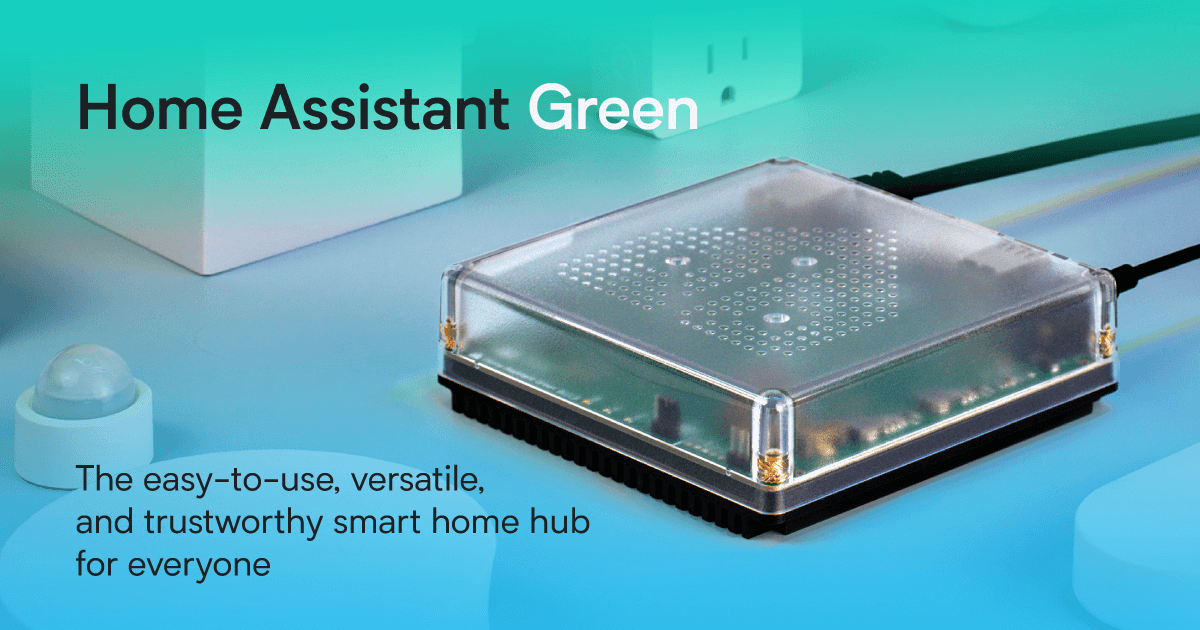
Home Assistant Green is a strong research-based choice for an owner who wants broad coordination and accepts the role of household system administrator.
Reasons to consider it
- Dedicated passively cooled automation hardware
- Broad integration approach without replacing every existing bridge
- Wired networking and USB expansion
Go in knowing
- Zigbee and Thread require a verified radio or network plan
- Cloud-dependent accessories retain their service dependencies
- Backups and configuration maintenance remain the owner's job
The specification sheet.
Published specifications from the linked sources. Configurations and availability can differ by country.
- Processor
- Quad-core 1.8GHz Arm
- Memory
- 4GB
- Storage
- 32GB eMMC
- Network
- Gigabit Ethernet
- Expansion
- Two USB 2.0 ports
- Radio caveat
- Current ZBT-2 page notes Thread support under development
A small box with a large job
Home Assistant Green is most interesting when the house has outgrown separate apps. Imagine a hallway light, a heating controller and a door sensor that all work individually but cannot agree on what arriving home should mean. A dedicated automation computer can coordinate that conversation. Green packages the computing side into an appliance, leaving the owner to choose the devices and rules. That distinction matters: buying the box does not complete the smart home, and its openness does not make every accessory equally accessible. Our assessment concerns the documented hardware and integration approach. We have not run a populated household on this unit, measured response times or tested recovery after a storage failure. Its promise is control over the system, with the responsibility that control brings.
The hardware proposition
Nabu Casa specifies a quad-core 1.8GHz processor, 4GB of memory and 32GB of eMMC storage, plus gigabit Ethernet and two USB 2.0 ports. Passive cooling avoids a fan. These are sensible ingredients for a small dedicated controller, but they are not a guarantee that every software workload belongs here. An owner collecting years of detailed sensor history has a different storage problem from someone operating a few lights. Camera recording, demanding image analysis and experiments with additional services deserve their own capacity assessment. We would choose Green primarily to coordinate home automation, then add heavier computing elsewhere if needed. Buying inexpensive hardware becomes poor value if its owner immediately asks it to replace an entire server cabinet without planning resources or backups.
Connection planning comes before shopping
Green's network connection is wired; Zigbee and Thread radios are additional considerations. The current product page names Connect ZBT-2 for expansion but also marks its Thread support as under development. We would not buy an accessory based on the assumption that an announced protocol path is finished. A useful shopping list starts with each existing device's exact model and integration requirements, then records whether it talks locally, needs its own bridge or depends on an online service. That exercise catches the expensive misunderstanding that a USB radio makes every device using a similar wireless label compatible. It also lets someone retain a working lighting bridge while gradually moving automation into Home Assistant, instead of making the entire household endure a simultaneous migration.
The first successful automation
The best initial project is a rule that is easy to observe and easy to undo. For example, a compatible entry sensor could trigger a compatible lamp during selected hours, with a physical switch still available. The point of that example is to expose the whole chain: detection, communication, a condition and an action. If the lamp behaves incorrectly, the owner has a manageable problem to diagnose. Starting with dozens of presence rules and heating changes makes attribution far harder. We would judge setup success by whether another resident understands the result, not by the number of devices on a dashboard. A tidy naming convention, rooms that match the actual house and a written explanation of exceptions will matter more after six months than an impressive first-day screenshot.
Local control needs local ingredients
Home Assistant emphasizes local data and operation. The important analytical boundary is the route taken by each integration. A local automation computer cannot make a cloud-only appliance continue accepting commands when that appliance's service is unavailable. Similarly, an online weather condition may prevent a rule from behaving as expected even when its light and sensor are nearby. We would draw the dependency chain for every important routine and decide what should happen when information is missing. Occupancy should not be assumed merely because a phone stops reporting. Lighting should have understandable manual controls. Remote access introduces another decision about authentication and exposure; the documented optional Home Assistant Cloud service may simplify that choice, but an owner still needs to secure their account and household access.
Maintenance is part of ownership
This is a software platform living inside a fixed appliance, so ownership includes keeping the configuration recoverable. We would establish a backup routine before adding complicated rules and keep a usable copy away from the controller. A recovery plan should include the administrator credentials, relevant device pairing information and a short account of which radios or bridges are attached. Updates deserve attention to release notes, especially when a home relies on a particular integration. That is not an argument against updates; it is an argument for being able to restore a working arrangement. Green removes much of the assembly work associated with a general-purpose board, but it does not remove the need for administration. A household without a willing administrator should account for that time honestly.
North American placement and costs
The published package includes a universal supply with US, EU and UK plug adapters, making regional sourcing more straightforward than a bare development board. Canadian buyers should still compare the actual seller's currency, taxes, shipping and return arrangements with US offers. Inside the home, choose a dry location near Ethernet that remains accessible when troubleshooting is needed. A closed network cabinet can be convenient for wiring yet awkward for later radio expansion; physical placement should follow the attached equipment, not just the prettiest shelf. The full cost includes any protocol radios, compatible sensors, remote-access service chosen and the owner's time. A bargain controller surrounded by unnecessary new accessories can easily cost more than retaining devices that already work through supported integrations.
How we would test it
A meaningful evaluation would install a representative set of local and cloud integrations, then record command delays under ordinary use and during deliberate network interruptions. We would distinguish an unavailable internet connection from an unavailable local network and from a failed accessory battery. Recovery testing would restore a saved configuration to suitable replacement hardware and verify that a second resident could follow the instructions. Longer observation would track database growth and update-related interventions rather than merely count integrations added. We would also test the dashboard on the actual household phones, including access restrictions for guests. None of those results can be inferred from processor speed. For Green, operational clarity and recoverability are at least as important as an instantaneous demonstration of a lamp switching on.
Who should choose Green
Home Assistant Green is a strong research-based choice for an owner who wants broad coordination and accepts the role of household system administrator. Its appeal is particularly clear when devices from several manufacturers already exist and replacing them all would be wasteful. Someone who wants a single brand's sensors with minimal configuration may find Aqara's approach easier to manage; a lighting-only home may obtain what it needs from a Hue bridge. Existing Home Assistant users should compare their actual resource needs before moving from a more capable computer. We would buy Green for a defined automation plan, a verified compatibility list and a maintainable backup routine. It is an approachable starting point for an open system, not evidence that maintaining an open system has become effortless.
Sources & further reading.
These are the sources behind this research review. Manufacturer claims are not independent performance measurements. Community accounts, when cited, describe individual experiences.
- Home Assistant Green — official product information ↗manufacturer
- Home Assistant Green installation and support ↗support
- Nabu Casa Green support collection ↗support
Documentation reviewed: 9 October 2026. Product software and regional bundles can change. Corrections and editorial disclosures.