An editorial assessment of documented capabilities and ownership trade-offs. This is not a hands-on test result or a measurement of reliability.
Features & capability 30%7.6
APS-C stills, 4K and tracking tools cover broad everyday work, with stabilization and audio limits.
Compatibility & connectivity 20%8.1
E-mount lens choice and a microphone input provide expansion in a compact system.
Ownership & upkeep 20%7.3
Small batteries and lens-dependent stabilization affect the complete kit cost.
Setup & everyday use 15%7.8
Lightweight handling and a flip-up screen help, though accessories can obstruct it.
Documentation & support clarity 15%8.4
Official specifications clearly document omitted features as well as supported functions.
Compare scores within the same product category. Small decimal differences should not override your needs or the evidence limits.
How the Standpoint Score works
We score five aspects of the documented product on a 0–10 scale, then calculate a weighted total:
- Features & capability30% of the total
- Compatibility & connectivity20% of the total
- Ownership & upkeep20% of the total
- Setup & everyday use15% of the total
- Documentation & support clarity15% of the total
This product’s 7.8/10 is a provisional research assessment. It does not claim measured performance, tested reliability or a verified customer satisfaction rate. Compare it with products in the same category, and read each criterion’s reasoning above.
Read the full rubric and score bands ↗The ownership case.
A sensible compact camera for learning, travel and planned short video, if the lens and power setup match the task. It is less self-contained for handheld filming than the feature list first suggests.
Reasons to consider it
- Small body works well with compact APS-C lenses
- Integrated flash and electronic finder broaden everyday use
- Tracking tools and customizable controls support learning
Go in knowing
- No sensor-shift stabilization in the body
- No headphone socket for direct audio monitoring
- Flip-up screen can conflict with accessories mounted above the camera
The specification sheet.
Published specifications from the linked sources. Configurations and availability can differ by country.
- Sensor
- 24.2 MP APS-C Exmor CMOS
- Autofocus
- 425 phase-detection and 425 contrast-detection points
- Maximum burst
- 11 fps, with conditions
- Stabilization
- No in-body stabilization; compatible lens stabilization supported
- Screen
- 3-inch touchscreen; tilts upward approximately 180 degrees
- Audio
- 3.5 mm microphone input; no headphone terminal
- Battery
- NP-FW50
Keep the kit as small as the reason for buying it
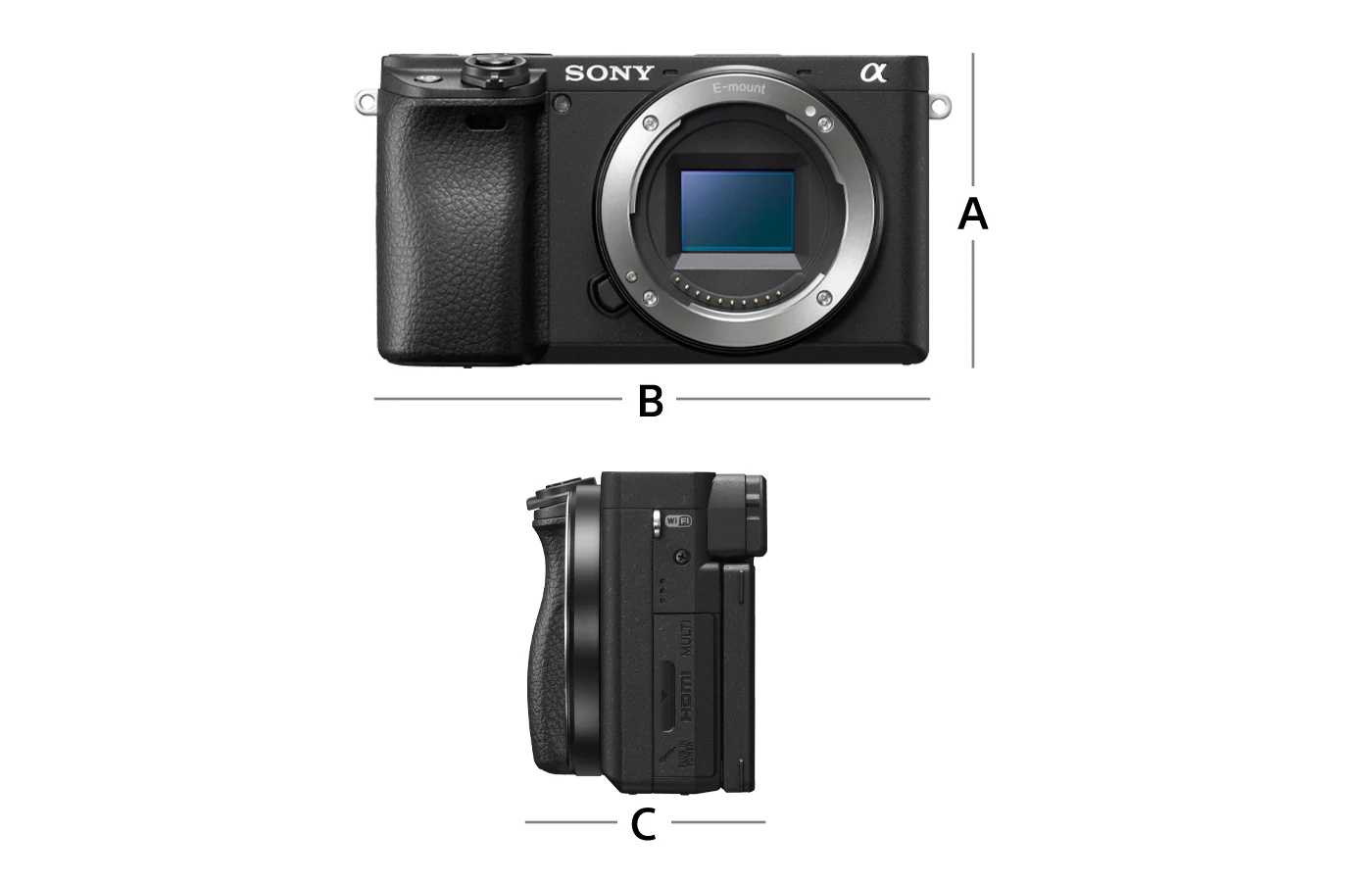
The Alpha 6400 is an appealing starting point for a camera that can travel without taking over the bag. Its value is easiest to see with a compact APS-C lens and a modest set of accessories. Attaching a large full-frame zoom can be useful for a particular assignment, but it changes the handling and defeats some of the reason for choosing a small body. Pick the lens and carrying arrangement before deciding that the camera will be comfortable on holiday or a daily walk.
This review concerns the original ILCE-6400. Check the exact model designation in listings and support pages, especially where a later regional variant uses an additional suffix. We assess the documented design and buying considerations rather than claiming measured focus accuracy or picture quality. A used camera's physical condition, included lens and battery health remain separate from the merits of the model. The cheapest body is not necessarily the least expensive way to obtain a dependable working kit.
APS-C resolution leaves room to learn technique
Sony specifies a 24.2-megapixel APS-C sensor. That gives many learners room to print, crop moderately and explore RAW processing without needing a resolution-specialist camera. The larger lesson is how focal length, aperture and shutter speed interact. An interchangeable-lens camera does not automatically make every photograph more pleasing than a phone; it gives the photographer more control and more opportunities to make a choice that does not fit the scene.
Choose a first lens around familiar subjects. Interiors and self-filming need a sufficiently wide view, while distant subjects may justify a longer lens. The APS-C angle of view differs from full frame at the same printed focal length, so compare framing rather than borrowing somebody else's favourite number. RAW files can preserve editing choices, but they require suitable software and a backup routine. JPEG capture can remain a useful practical option while learning exposure and composition. There is no need to adopt the most complicated workflow immediately.
Stabilization is a lens decision on this body
The A6400 does not contain a sensor-shift stabilization system. Sony explicitly describes stabilization as dependent on a compatible lens. This matters when comparing kits and when replacing a stabilized zoom with a small prime. The body has not suddenly become faulty if the handheld behaviour changes; the system's stabilization arrangement has changed with the lens. Check the exact lens specification before treating every E-mount option as interchangeable for low-shutter-speed photography.
For moving subjects, stabilization would not solve the whole problem anyway. A child's expression or a pet's movement can require a faster exposure even when the camera is held steadily. For video, consider support, movement and framing together. A small tripod, careful handheld technique or a suitable stabilized lens may serve a particular project, but each changes the kit. The A6400 is most comfortable when these choices are planned, rather than when a buyer expects the body alone to deliver smooth walking footage in every situation.

Tracking features need a clear operating routine
The documented hybrid system includes 425 phase-detection and 425 contrast-detection points, with tracking and eye-related tools highlighted in Sony's model overview. The useful question is how easily you can tell the camera what to follow. A learner should practise selecting a subject and changing focus-area behaviour in ordinary scenes before attempting a crowded event. Automatic recognition can reduce some effort without understanding the photographer's intention every time several possible subjects enter the frame.
The maximum eleven-frame-per-second rate is qualified by shooting conditions and settings. It describes capture speed, not the proportion of frames that will meet a particular sharpness standard. During a used-body trial, make a short sequence with a familiar lens and inspect more than one frame. Also check single-shot focus on a small stationary detail. These are suggested purchase checks, not results from our own testing. A slower deliberate sequence can be easier to follow and sort than a maximum-rate burst used without a reason.
The screen and audio sockets shape a video setup
The rear display tilts upward approximately 180 degrees, allowing self-framing. That is useful until an accessory mounted above the camera obstructs the view. A microphone, bracket or other shoe-mounted device can change how visible the screen remains. Try the intended arrangement before buying several accessories to solve one another's placement problems. For ordinary still photography, the same tilting mechanism is helpful at unusual viewpoints, but it is not the same arrangement as a side-opening articulated screen.
Sony lists a microphone input and no headphone terminal. An external microphone can improve how sound is captured in a particular setup, yet direct monitoring requires another solution. For an interview, a brief recording and playback check is essential; a visible level meter alone cannot reveal every unwanted noise. The 4K recording capability is useful for planned clips, but this review does not establish thermal endurance or rolling-shutter behaviour. Test the actual recording mode, support, microphone and editing workflow before treating the camera as a complete production system.
Flash and compact power are practical distinctions
The built-in flash is convenient for occasional fill and for learning the relationship between ambient and added light. It is a small source with limited reach, not a replacement for deliberate portrait lighting. Check whether the attached lens casts a shadow at close distances and try the flash in the situations where you expect to use it. The presence of this feature can be valuable precisely because it is available without packing a separate unit for every outing.
The NP-FW50 battery is another part of the compact design. Plan charging and spares according to the actual schedule rather than treating Sony's CIPA figure as a personal daily guarantee. Long periods of composing, wireless use and video create different demands from occasional stills. A used pack may have substantially less capacity than when new. Identify the supplied battery, inspect the compartment and verify the charging arrangement. An inexpensive kit that immediately requires dependable batteries and a charger should be compared on that complete cost.
Used inspection should include the lens and connections
The screen hinge, card access, mount and ports deserve close attention on a small camera that may have travelled frequently. Test the flash release, dials, buttons and electronic finder as well as the rear display. If a power zoom is included, operate it repeatedly and check that it extends, focuses and retracts normally. A clean body does not compensate for a damaged bundled lens. Ask about repairs and obtain the model and serial information needed to identify what is actually being sold.
Wireless transfer can be convenient, but app and phone requirements evolve. Try pairing with the device you intend to use and keep a card-reader method available for important files. Store the camera dry, protect the mount when changing lenses and follow Sony's cleaning guidance. For Canadian or US secondhand purchases, confirm original sales territory and local service options. Do not assume that a UK feature page or a cross-border listing establishes local stock, transferable warranty or the availability of a particular replacement part.
The ownership case is about a focused set of needs
Sony retains a model-specific download route and detailed specifications for the original A6400. Check the installed firmware against that route and read any operating-system requirements before attempting an update. Old tutorials may describe applications or interfaces that no longer match the current setup. Accessible documentation is useful for an older camera, but it is not a commitment to future feature additions. Build the buying decision around functions already documented for the exact model.
The strongest case is a compact stills kit that can also make planned video when its limitations are understood. If handheld filming, direct audio monitoring or extended battery endurance dominates the requirement, price the accessories and alternatives before choosing this body. If the priority is learning photography with an electronic finder, useful focus tools and interchangeable lenses, the design remains coherent. A carefully inspected example with a suitable lens can be more valuable than a newer body paired with equipment that does not match the subjects. The final choice should follow that complete working arrangement.
Sources & further reading.
These are the sources behind this research review. Manufacturer claims are not independent performance measurements. Community accounts, when cited, describe individual experiences.
- Sony Alpha 6400 official specifications ↗manufacturer
- Sony Alpha 6400 official model overview ↗manufacturer
- Sony ILCE-6400 downloads ↗support
Documentation reviewed: 9 October 2026. Product software and regional bundles can change. Corrections and editorial disclosures.