An editorial assessment of documented capabilities and ownership trade-offs. This is not a hands-on test result or a measurement of reliability.
Task capability 30%9.0
Large build cube and active chamber heating give a broad documented project envelope.
Control & connectivity 20%8.4
USB, Ethernet and dual-band Wi-Fi provide useful paths; current cloud features require verification.
Ownership & upkeep 20%7.4
Heavy installation, feeder preparation and large-part failures increase the ownership burden.
Setup & usability 15%7.3
Automated calibration helps, but placement and accessory setup are substantial.
Documentation & support clarity 15%7.7
Dedicated specifications and downloads exist, though support retains an outdated cloud-slicing promise.
Compare scores within the same product category. Small decimal differences should not override your needs or the evidence limits.
How the Standpoint Score works
We score five aspects of the documented product on a 0–10 scale, then calculate a weighted total:
- Task capability30% of the total
- Control & connectivity20% of the total
- Ownership & upkeep20% of the total
- Setup & usability15% of the total
- Documentation & support clarity15% of the total
This product’s 8.1/10 is a provisional research assessment. It does not claim measured performance, tested reliability or a verified customer satisfaction rate. Compare it with products in the same category, and read each criterion’s reasoning above.
Read the full rubric and score bands ↗The ownership case.
A promising research shortlist machine for genuinely large filament parts and controlled-temperature work. Its size, accessory requirements and older support-page promises need more scrutiny than a speed headline.
Reasons to consider it
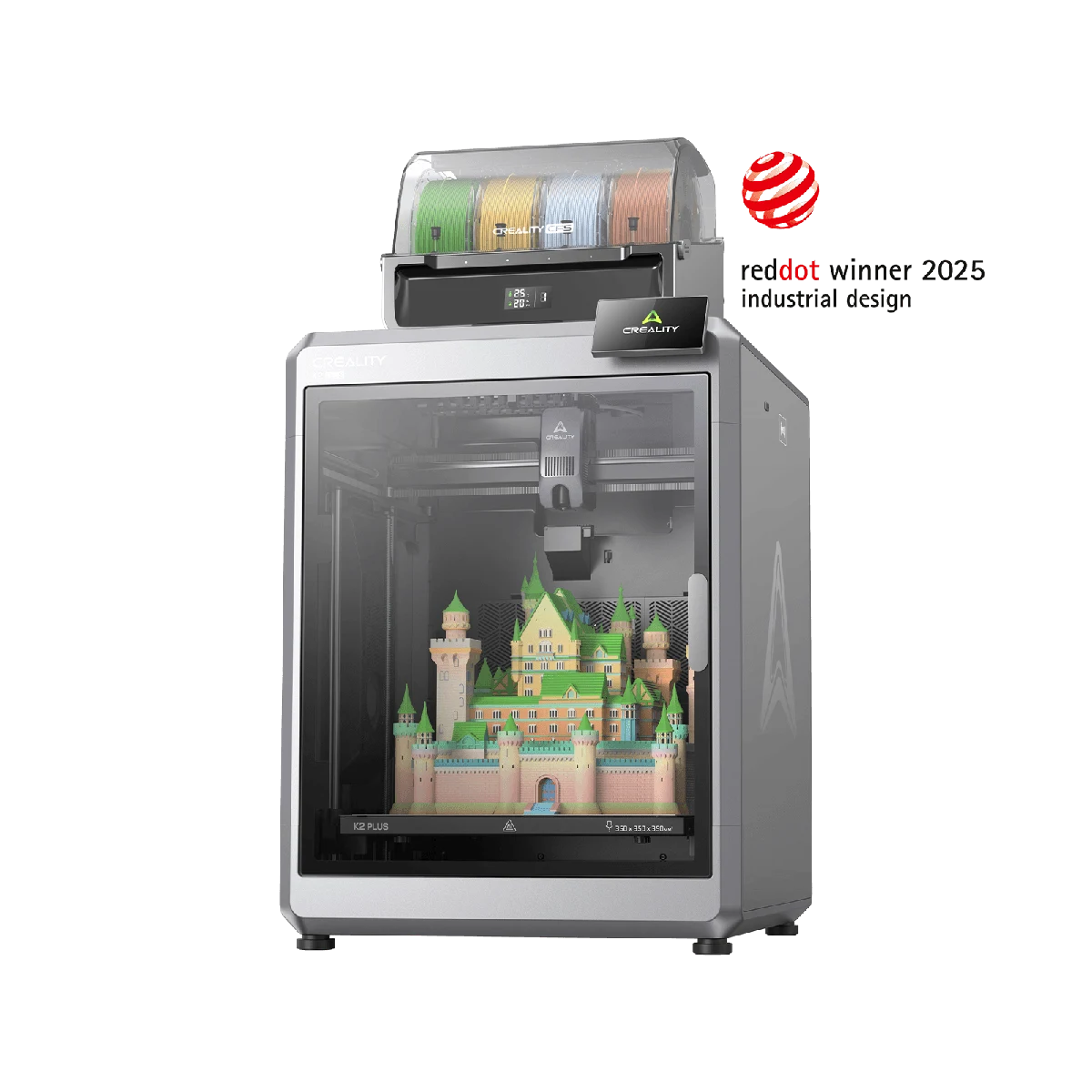
- 350 mm build cube gives useful single-piece capacity
- Active chamber heating is documented up to 60°C
- USB, wired and wireless LAN options alongside cloud connectivity
Go in knowing
- Large heavy installation demands a suitable bench and access
- CFS capabilities and material compatibility differ from direct spool feeding
- Some official support text retains old future-tense feature timing
The specification sheet.
Published specifications from the linked sources. Configurations and availability can differ by country.
- Build volume
- 350 × 350 × 350 mm
- Temperature limits
- 350°C nozzle; 120°C bed; 60°C chamber
- Maximum motion
- 600 mm/s; 30,000 mm/s² acceleration
- Printer dimensions
- 495 × 515 × 640 mm, before accessory clearance
- Published printer weight
- 35 kg
- Material expansion
- Optional CFS; up to four units / sixteen filaments per manufacturer
Buy the large volume for a real part
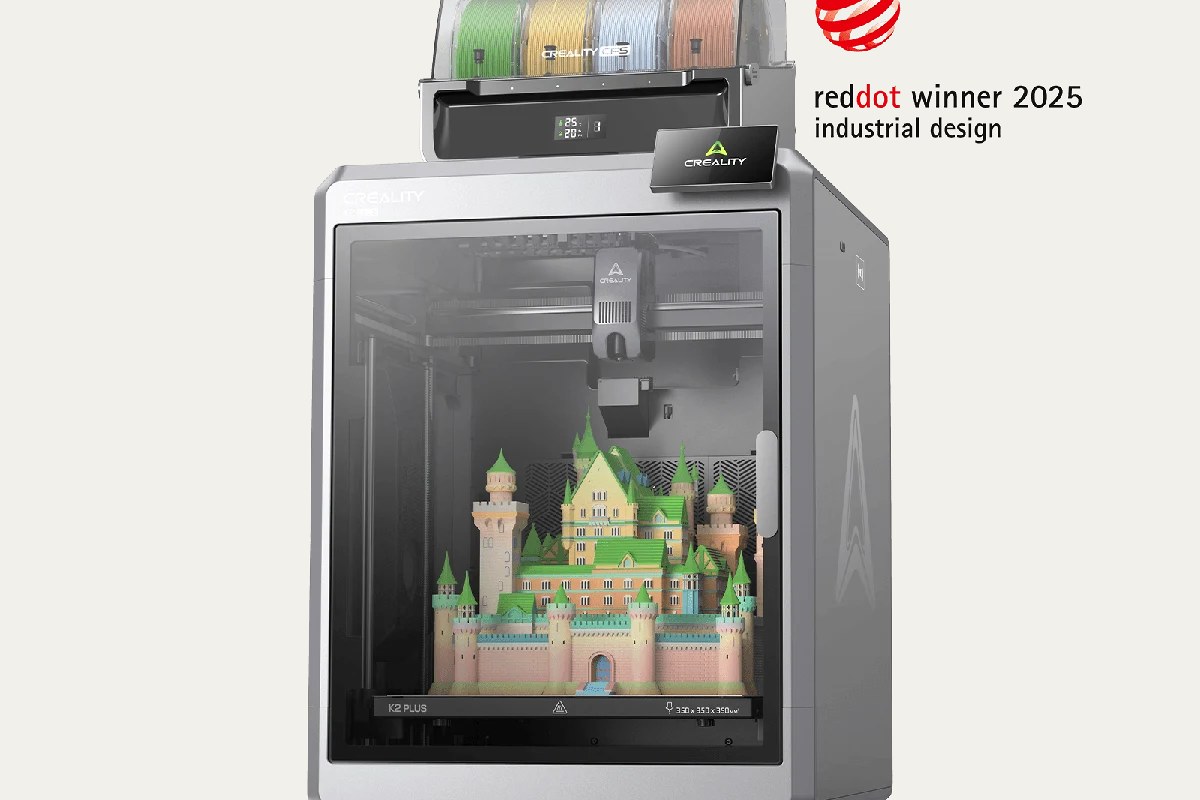
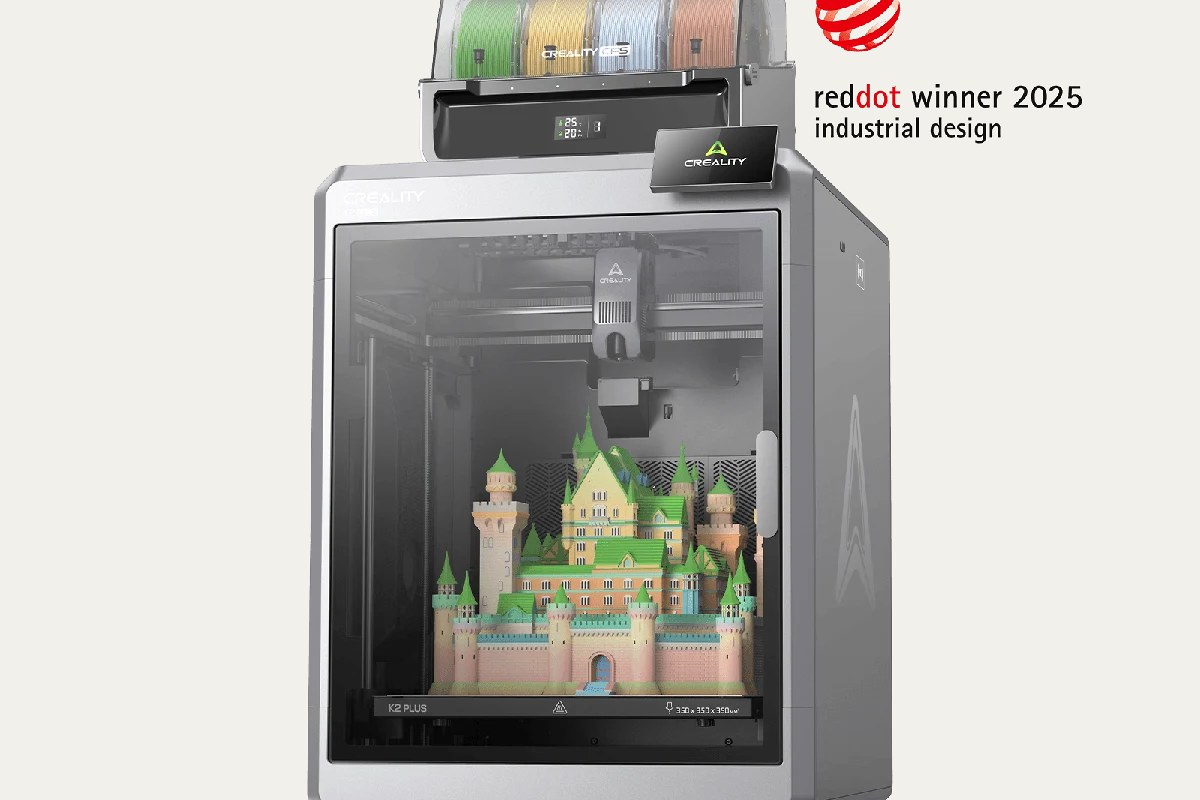
The K2 Plus makes the most sense when a smaller printer imposes an actual design compromise. A large enclosure shell, a broad fixture or a substantial costume component can be awkward to divide, align and bond. The 350 mm build cube gives such projects more room in one piece. It is a weaker argument for someone whose normal output is a handful of small figurines. This review examines the documented machine and the costs implied by its architecture; it does not claim that we have measured the K2 Plus's accuracy, print success rate or maximum practical speed.
A larger bed can also accommodate a batch of small parts, but batching is not free productivity. A late failure risks more material, and a full plate complicates access, cooling and scheduling. Compare one long batch with several smaller runs in the slicer before assuming capacity translates directly into faster delivery. For fitted parts, use the added area to print representative test pieces and validate orientation before committing to the largest version. The most expensive failed print can be the one that reaches completion but does not fit the assembly it was designed for.
A real workshop installation
The published machine dimensions are approximately 495 by 515 by 640 mm, with a stated printer weight of 35 kg. The CFS arrangement adds further space above or beside it. This is a bench-planning decision as much as a specification comparison. Leave room to handle spools, open the door, remove the build plate and reach maintenance points. A narrow shelving unit that can physically contain the printer may be unsuitable if its structure vibrates or prevents access. Plan how the machine will get from its delivery location to the working surface before it arrives.
The large chamber and heated components also mean placement should support an appropriate electrical supply and the manufacturer's operating guidance. Do not read a rated-power number as a continuous consumption measurement; heating and printing phases differ. Our eventual ownership test would measure a representative sequence from cold start through completion, because an impressive motion speed does not describe the time spent warming a large system. For a user making many short parts, preparation and cooldown can influence daily throughput more than the fastest line printed during the middle of a job.
Thermal capability is the central feature
Creality documents an actively heated chamber up to 60°C, a 120°C bed and a 350°C nozzle. The chamber specification is the more distinctive part of this combination. Keeping the environment around a large part controlled addresses a different problem from simply making the nozzle hotter. Broad sections and sharp corners can still challenge adhesion and dimensional stability, so a material name on a compatibility list is a starting point for profile selection rather than a promise of a flawless full-volume print. Filament drying and a suitable build surface remain part of the process.
The manufacturer's support table lists hardened-steel nozzle hardware and several engineering and filled materials. That supports considering the K2 Plus for more than decorative PLA, but does not make every brand or formulation interchangeable. Check the filament supplier's requirements, the selected nozzle size and the route through any automated feeder. We would test layer bonding and dimensional change on the exact material intended for a functional part. A visually attractive sample does not establish its suitability for a loaded or heat-exposed application, and the printer's enclosure is not evidence that room ventilation can be ignored.
Motion, extrusion and monitoring
The quoted limits of 600 mm/s and 30,000 mm/s² are ambitious, but they should not dominate the buying decision. Large simple paths can make more use of a high motion ceiling than intricate small features. The hotend must also deliver enough material at the requested line width and layer height. A sensible comparison therefore slices the same real project with the appropriate material profile, then checks wall finish and fit at that setting. We would not convert a promotional benchmark into an expected completion time for a mechanically different customer model.
Creality describes closed-loop motor control, automatic calibration and camera-based assistance across the K2 Plus platform. These are useful mechanisms to investigate, not evidence that failures become impossible. A camera can help reveal a detached part, while calibration can reduce setup variability; neither establishes internal strength or catches every feed problem. The acceptance procedure should include more than the supplied demonstration file: a broad first-layer pattern, a dimensional fit piece and a longer run with the intended spool. Save the profiles and machine state so later changes can be compared with a known starting point.
CFS requires a separate material decision
The Creality Filament System gives the printer an automated route to multiple colors and materials. The advertised maximum of sixteen filaments requires multiple CFS units, not the standalone printer alone. Its storage and desiccant arrangement should not be confused with active heated drying. If a spool needs drying before printing, a sealed feeder does not automatically undo moisture already absorbed. This distinction is especially important for buyers attracted by the machine's engineering-material capabilities, where storage history and preparation can strongly affect the usefulness of an expensive print.
Compatibility is narrower at the feeder than at the nozzle. Creality's CFS guidance excludes flexible TPU and warns about material or spool conditions that can interfere with feeding. Verify spool dimensions and the supported material list rather than transferring an external-spool success into an assumption about automated switching. Multicolor work also incurs transition time and purge material. A large single-color part may exploit the K2 Plus far better than an elaborate tiny print with repeated color changes. The question is whether automated changes remove an actual labor bottleneck in your work, not whether the machine can display the largest color count.
Software, support and the final calculation
The official support page documents USB-drive, LAN and cloud transfer, including Ethernet and dual-band Wi-Fi. Wired local access is valuable for a permanent workshop station where wireless reception is inconsistent. The same support page still contains future-tense text about cloud slicing expected in December 2024, which is plainly older than this review. We therefore do not treat that passage as proof of current cloud-slicing capability. Verify the exact firmware and desired function in the current documentation or interface. Stale explanatory text is a reason to be precise, not to assume that every promised feature either arrived or failed.
For Canada and the US, obtain the regional model, plug, seller warranty and delivery arrangement for the actual order. A large machine's return process can matter substantially if service requires shipping, so keep packaging and ask how a repair would be handled before discarding it. Compare the K2 Plus against a smaller enclosed printer using the parts you really intend to make. It earns its provisional place through volume, thermal control and connectivity. Hands-on thermal consistency, feeder recovery, noise and access for routine repairs remain the important unknowns before we could call it a dependable production tool.
Sources & further reading.
These are the sources behind this research review. Manufacturer claims are not independent performance measurements. Community accounts, when cited, describe individual experiences.
- Creality K2 Plus Combo — official product listing ↗manufacturer
- K2 Plus specifications and connectivity support ↗support
- K2 Plus and CFS manufacturer FAQ ↗support
- K2 Plus official downloads ↗manual
- K2 Plus global product and CFS specifications ↗manufacturer
Documentation reviewed: 9 October 2026. Product software and regional bundles can change. Corrections and editorial disclosures.