An editorial assessment of documented capabilities and ownership trade-offs. This is not a hands-on test result or a measurement of reliability.
Task capability 30%8.5
Controlled enclosure and useful volume, with material-specific accessory requirements.
Control & connectivity 20%9.1
Explicit local PrusaLink plus Ethernet and optional cloud workflow are well documented.
Ownership & upkeep 20%8.8
Repair and upgrade paths are described in depth; exact generation and parts still matter.
Setup & usability 15%8.2
Automatic calibration and assembled option help; kit and accessories require deliberate configuration.
Documentation & support clarity 15%9.1
Detailed repair index and clear local/cloud distinction support a comparatively strong documentation assessment.
Compare scores within the same product category. Small decimal differences should not override your needs or the evidence limits.
How the Standpoint Score works
We score five aspects of the documented product on a 0–10 scale, then calculate a weighted total:
- Task capability30% of the total
- Control & connectivity20% of the total
- Ownership & upkeep20% of the total
- Setup & usability15% of the total
- Documentation & support clarity15% of the total
This product’s 8.7/10 is a provisional research assessment. It does not claim measured performance, tested reliability or a verified customer satisfaction rate. Compare it with products in the same category, and read each criterion’s reasoning above.
Read the full rubric and score bands ↗The ownership case.
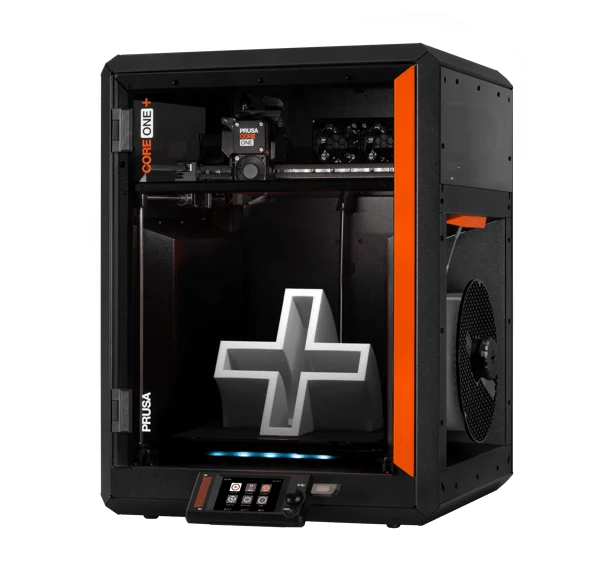
A compelling documented fit for makers who value repair instructions and local control as much as print automation. Buy the exact generation and accessory package needed, rather than assuming every CORE One photograph shows the same configuration.
Reasons to consider it
- PrusaLink provides local-network printing and monitoring
- Published maintenance and component-replacement guidance
- Current Gen 2 changes target belts, heatbed mounting, nozzle cleaning and access
Go in knowing
- 250 × 220 mm bed is not a 256 mm square
- Multimaterial and filtration equipment must be checked as separate options
- Newer Gen 2 and older CORE One/+ stock should be distinguished
The specification sheet.
Published specifications from the linked sources. Configurations and availability can differ by country.
- Reviewed version
- CORE One+ (Gen 2), current official page
- Build volume
- 250 × 220 × 270 mm
- Thermal limits
- 290°C nozzle; 120°C bed; 55°C chamber
- Published machine size
- 415 × 444 × 555 mm; allow operating clearance
- Published weight
- 22.5 kg
- Connectivity
- Ethernet, Wi-Fi; PrusaLink local control and Prusa Connect cloud service
A purchase built around long-term access
The CORE One+ asks a different first question from a printer whose presentation is dominated by a maximum speed: what will it be like to own, maintain and adapt the machine? Its appeal in the documents is the combination of an enclosed CoreXY platform, accessible support material and a choice of local or cloud control. Those attributes are useful to a workshop that expects to keep a printer working through changing projects. They do not establish its real-world accuracy or reliability; this review is based on current primary documentation, with hands-on testing still outstanding.
Version identification matters unusually much here. The current page reached during research describes CORE One+ Gen 2, including changed belts, heatbed mounting, a silicone nozzle wiper and a removable top panel. This article therefore covers that current offering, rather than assigning its improvements to an older CORE One in a reseller's warehouse. The brand also advertises upgrade paths. An existing owner should compare the upgrade contents against the hardware already installed, while a new buyer should obtain the generation and included accessories in writing on the order.
The enclosure and build space in practice
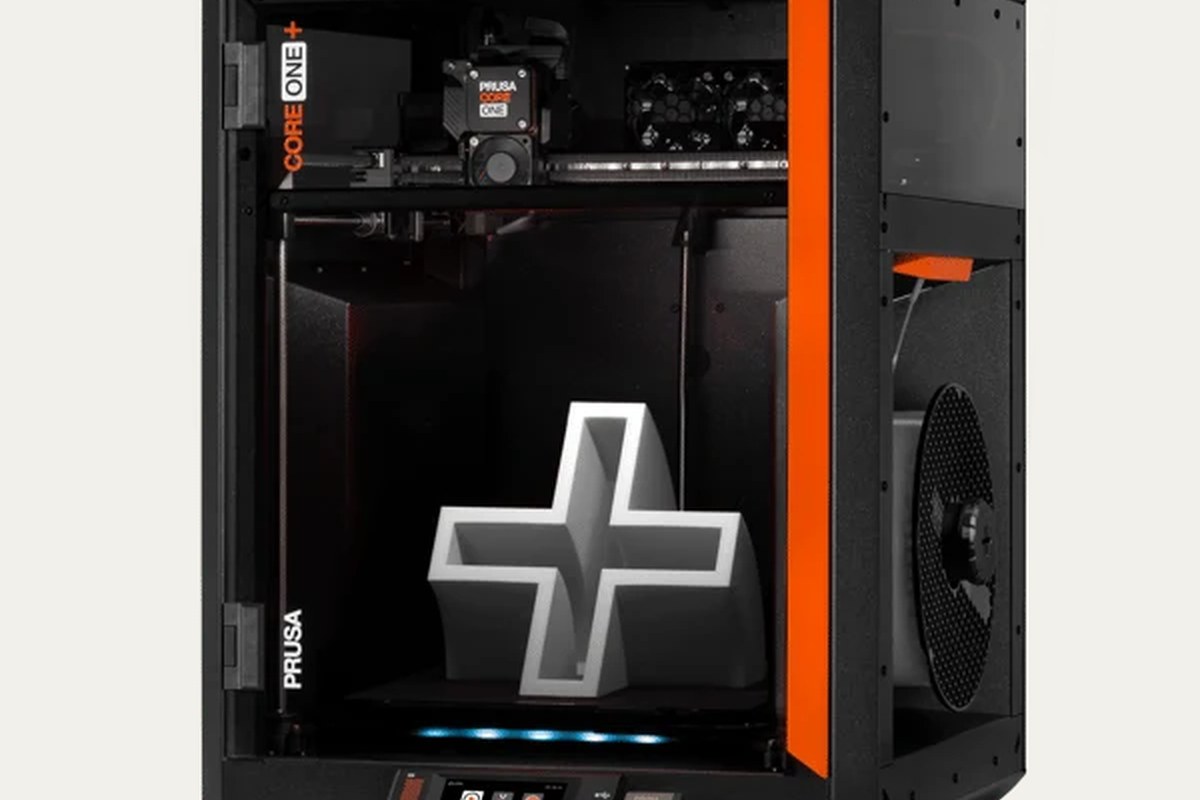
The published build volume is 250 by 220 by 270 mm. That rectangle is a meaningful difference from the 256 mm cubes common elsewhere: a wide tray may need reorientation or segmentation even though this printer offers extra vertical room. The stated 415 by 444 by 555 mm machine envelope is only a starting point for placement. Door movement, spool handling, access to the top and room to remove a finished part all belong in the bench plan. A tightly fitted cubby could undermine the service access that makes the design attractive in the first place.
Prusa specifies maximum nozzle, bed and chamber temperatures of 290°C, 120°C and 55°C respectively. Consider them as a system rather than ranking this printer solely by the nozzle figure. An enclosure that manages the environment around a part can be valuable for larger thermally sensitive geometries. It still cannot guarantee that every spool labeled PC or nylon will behave identically. The material maker's drying requirements, the selected sheet and the part's cross-section remain important. Our most revealing thermal test would use broad flat shapes and tall walls, not just a small part that happens to finish.
What the Gen 2 changes could mean
Prusa presents the new belt arrangement as a way to reduce fine surface patterns. That is a specific claim worth testing on long smooth walls, where a repeating pattern is easier to see than on a highly textured figurine. Without side-by-side samples we cannot assign a measured improvement. The ownership implication is that motion components and their adjustment remain relevant even on an automated printer. A buyer should preserve a baseline surface sample and its profile before changing belts, firmware or acceleration, so the effects of an upgrade can be assessed coherently.
The nozzle wiper and revised heatbed mounting address different parts of startup. A cleaner nozzle can make the beginning of a print more predictable, while shorter preparation can matter for someone who runs many small jobs each day. Neither benefit should be converted into an invented minutes-saved figure. The snap-on top panel is more tangible in the ownership calculation: access is important when a feed path needs inspection or a component eventually needs replacement. We would evaluate whether routine tasks can be completed without rearranging the whole bench, because convenience on day one and convenience during maintenance are not the same thing.
An unusually clear local-control choice
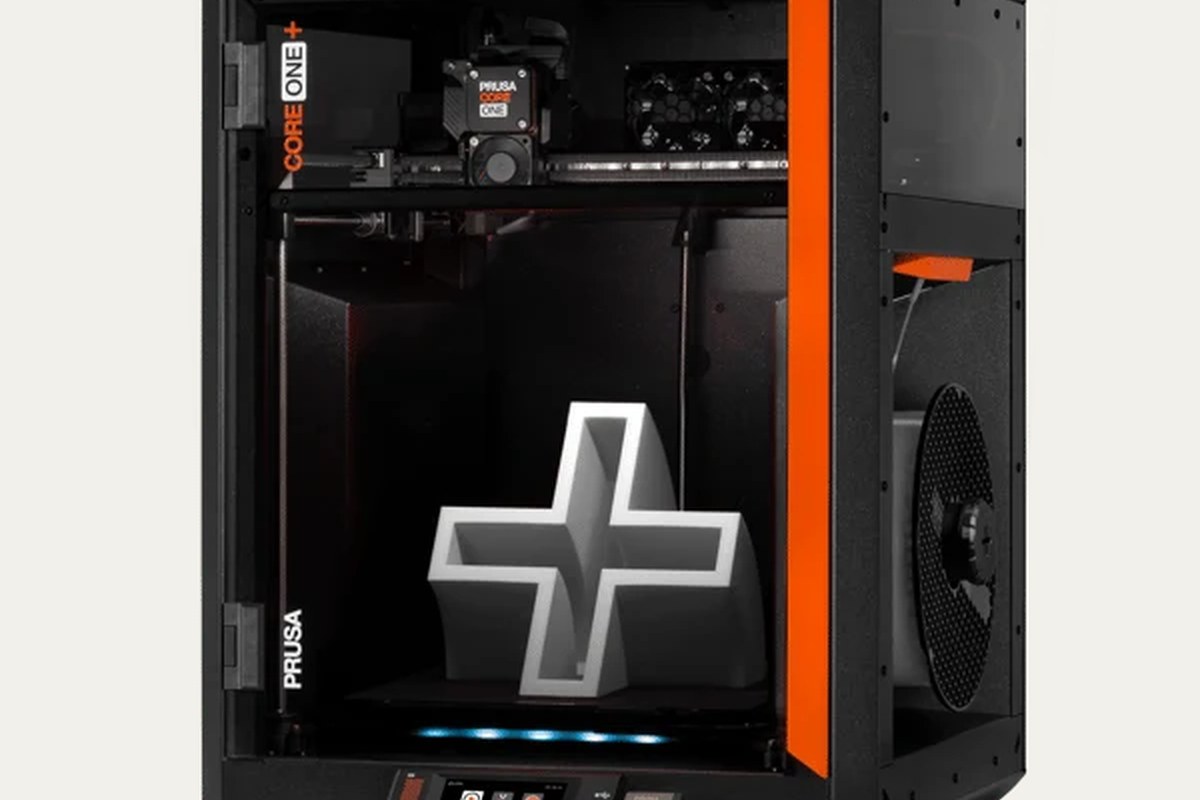
Prusa's support documentation makes a helpful distinction: PrusaLink runs locally on the printer, while Prusa Connect is the cloud service. Link supports monitoring, file uploads and print control without internet access on the local network. For a workshop handling unreleased designs, that distinction is more actionable than a vague promise of connectivity. A wired Ethernet connection is also useful when the printer's permanent location has poor wireless reception. Decide which workflow fits the project files before adding remote services, rather than discovering the distinction after sensitive models have already been uploaded.
The surrounding software ecosystem offers several levels of involvement, from PrusaSlicer on a computer to web and mobile services. These routes should be assessed by the actual job. A quick downloaded model may suit a simplified path, while a fitted mechanical component deserves explicit review of orientation, supports, tolerances and material settings. Keep the project file, not merely the final G-code, when a part will need later revision. Local control is a strength of the documented platform, but it does not automatically resolve account policy, network security or third-party model licensing for a business using the printer.
Kit, assembled machine and optional systems
The kit and assembled versions serve different buyers. Building the kit can provide a useful mental map of the machine, especially for someone who expects to perform repairs. It also consumes focused time and transfers more responsibility for careful assembly to the owner. A workshop buying capacity for immediate deadlines may reasonably prefer an assembled machine even if the kit has a lower purchase price. Compare the value of that time and the ability to diagnose problems, not just the number at checkout. Either route still requires space, material setup and an initial acceptance print.
The current product page advertises an INDX multimaterial upgrade with as many as eight materials or colors. That is an accessory path, not a feature to assume on every base CORE One+. Confirm its exact generation compatibility, included hardware and availability at purchase. Likewise, the official material list associates several materials with the Advanced Filtration System. Do not read a material name in isolation and assume every photographed configuration contains that filter. A buying list should name the printer, nozzle, build sheet, filtration and material-handling equipment needed for the intended projects. This prevents an apparently complete order from depending on an unbudgeted addition.
Service documentation as a measurable benefit
Prusa's maintenance index includes instructions for replacing the heatbed, thermistors, fans, sensors, motors and other components, alongside packing guidance for returns. The existence of those instructions is a concrete advantage for an owner who wants to understand the service path before something fails. It does not prove that any repair is easy or that every part will always be stocked locally. Review a representative procedure and replacement-part listing before purchase. If the owner is unwilling to perform it, find out which seller or service provider would handle that work and what shipping would involve.
The manufacturer page served Canadian pricing and regional purchasing links during research, while its broader storefront also supports US buyers. We have not established a particular delivery date or cross-border service entitlement. Confirm destination, duties where applicable, warranty terms and the exact generation at checkout. The CORE One+ earns a strong provisional assessment for ownership clarity and control options. A full test would still need to examine dimensional fit across the bed, startup repeatability, thermally demanding parts, maintenance access and noise. Those results, rather than the manufacturer's impressive internal-farm statistics, would determine our eventual measured verdict.
Sources & further reading.
These are the sources behind this research review. Manufacturer claims are not independent performance measurements. Community accounts, when cited, describe individual experiences.
- Prusa CORE One+ — current Gen 2 product page ↗manufacturer
- Prusa Connect and PrusaLink explained ↗support
- CORE One+ maintenance and replacement guide index ↗manual
Documentation reviewed: 9 October 2026. Product software and regional bundles can change. Corrections and editorial disclosures.