An editorial assessment of documented capabilities and ownership trade-offs. This is not a hands-on test result or a measurement of reliability.
Task capability 30%7.2
Focused geometry suits small planar manipulation tasks.
Navigation & control 20%7.7
Several control options support teaching and prototypes.
Ownership & upkeep 20%7.0
Small modular platform is manageable but needs mechanical care.
Setup & usability 15%7.0
Fewer axes simplify some tasks without eliminating integration.
Documentation & support clarity 15%7.6
Official resources explain scope, with cross-model tutorial caution needed.
Compare scores within the same product category. Small decimal differences should not override your needs or the evidence limits.
How the Standpoint Score works
We score five aspects of the documented product on a 0–10 scale, then calculate a weighted total:
- Task capability30% of the total
- Navigation & control20% of the total
- Ownership & upkeep20% of the total
- Setup & usability15% of the total
- Documentation & support clarity15% of the total
This product’s 7.3/10 is a provisional research assessment. It does not claim measured performance, tested reliability or a verified customer satisfaction rate. Compare it with products in the same category, and read each criterion’s reasoning above.
Read the full rubric and score bands ↗The ownership case.
myPalletizer 260 is a credible choice for lightweight four-axis manipulation lessons and compact pick-and-place prototypes.
Reasons to consider it
- Simple four-axis geometry
- Graphical and code control
- Compact reach
Go in knowing
- Orientation is limited versus six-axis arms
- Tooling consumes payload
- Integration and safety remain user work
The specification sheet.
Published specifications from the linked sources. Configurations and availability can differ by country.
- Axes
- 4
- Working radius
- 260 mm
- Payload
- 250 g
- Development
- Graphical tools, Python and other supported interfaces
Four axes can be the right amount of robot
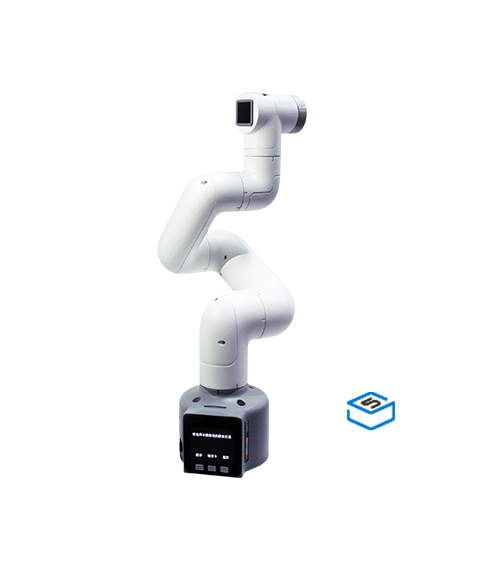
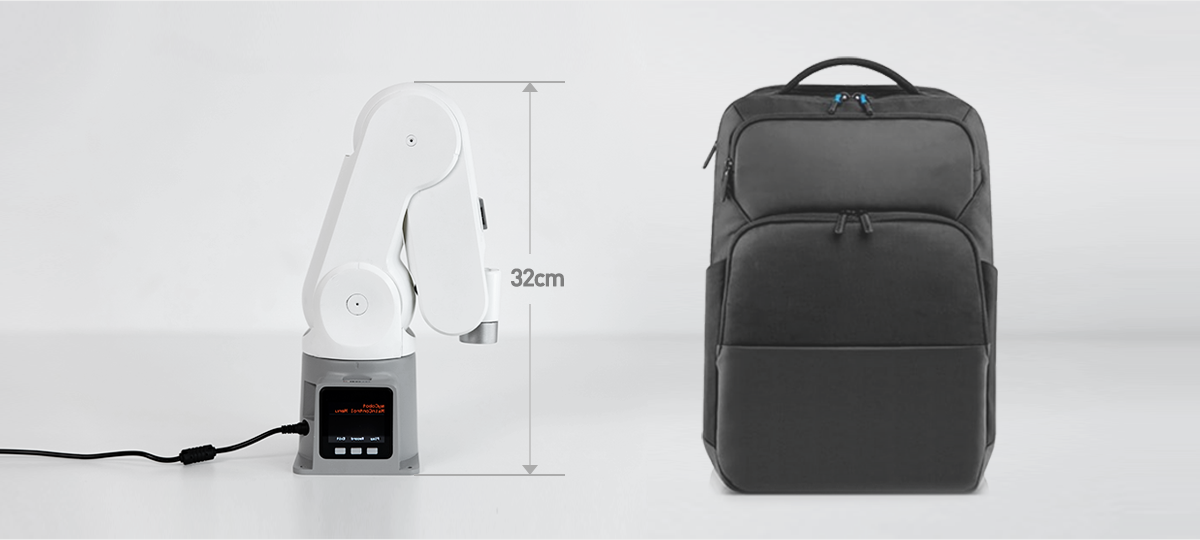
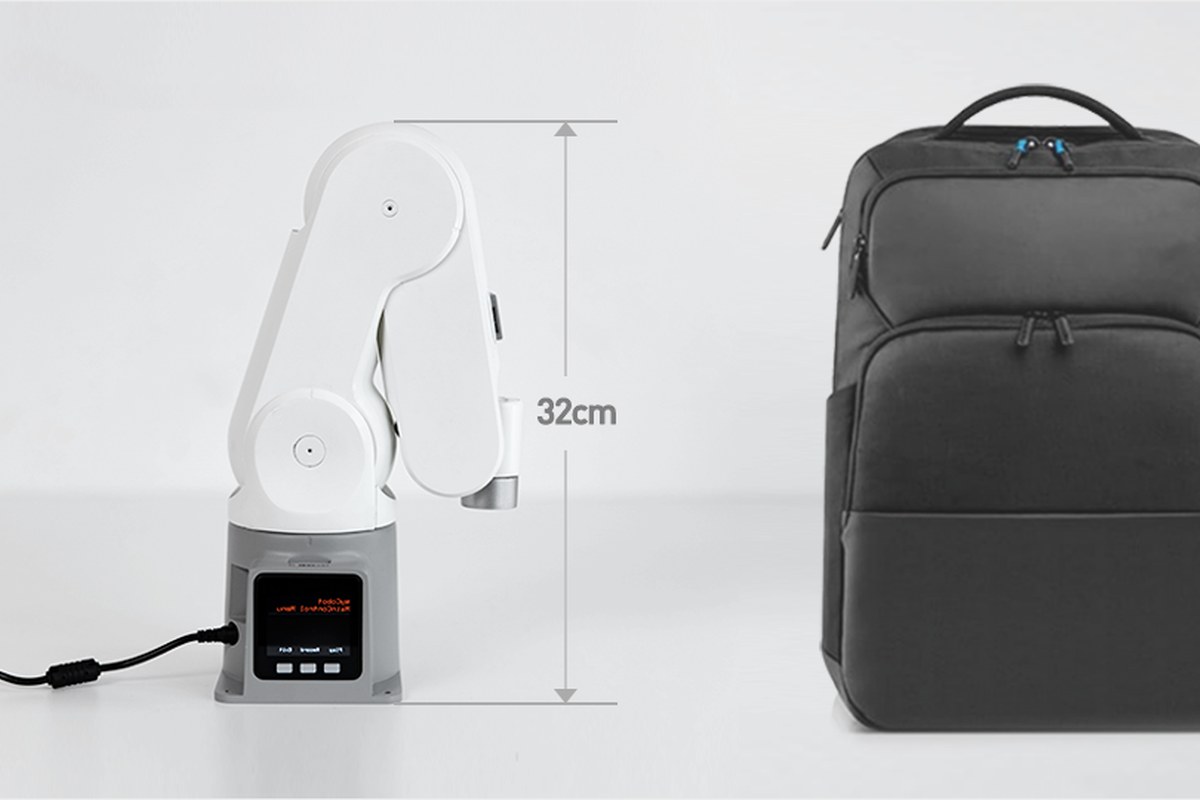
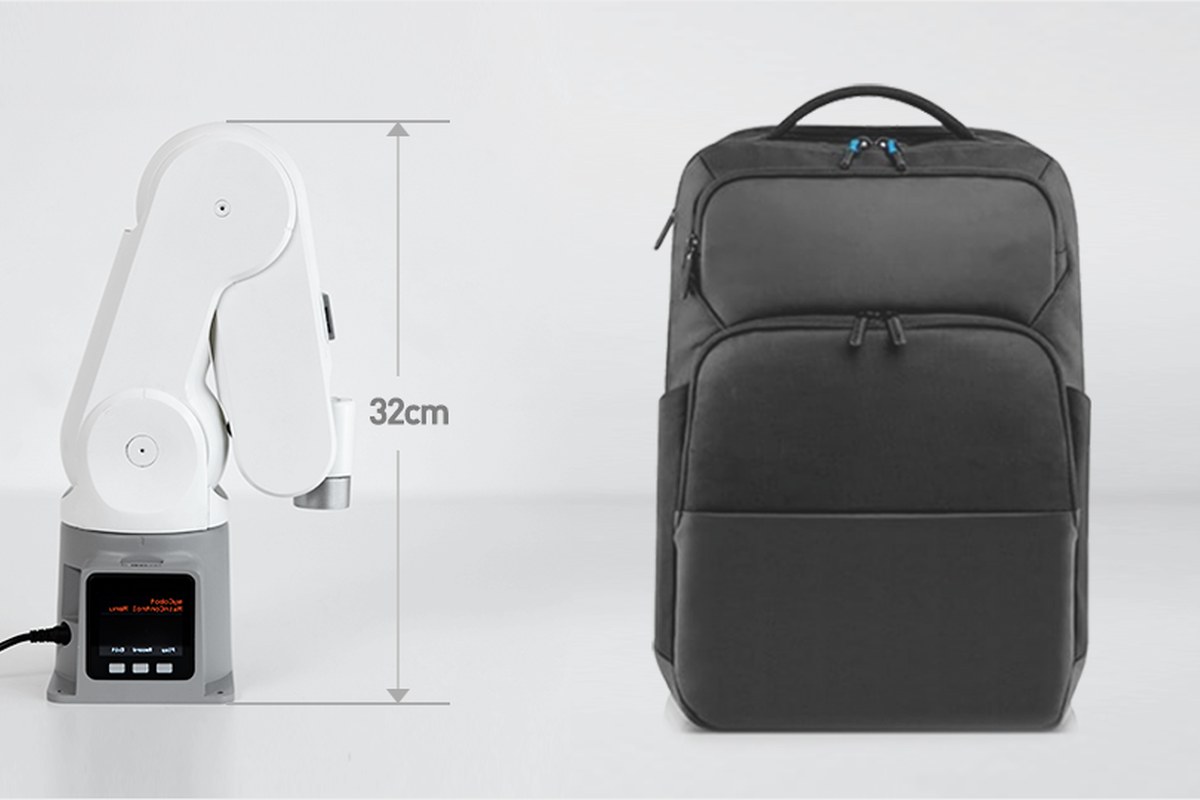
The myPalletizer 260 is a compact four-axis desktop arm with a published 260mm working radius and 250g payload. Elephant Robotics positions it for teaching, small pick-and-place demonstrations and maker applications, with graphical and code-based control options. Its appeal is a relatively understandable manipulation geometry: it can illustrate moving a tool between positions without the full orientation complexity of a six-axis arm. That is useful when the task is placing small objects on a surface or demonstrating a miniature warehouse. It is limiting when arbitrary tool orientation is required. We have not operated the arm. This review considers the documented mechanism and the project decisions that determine whether its deliberate simplicity is an advantage.
Start with the orientation requirement
Before choosing an arm, describe how the tool must face at every stage of the task. Four axes may be sufficient for top-down picking and placement while leaving other orientations unavailable. A six-axis model is not automatically better if the extra joints add complexity without solving a real need. Conversely, discovering an orientation limitation after building fixtures can make a cheaper arm an expensive mistake. Sketch the pickup, travel and placement poses, then compare them with the documented workspace. A maximum radius does not guarantee that every point within it is reachable in a useful configuration. We would validate the intended poses in a supported simulation or carefully controlled physical trial before designing the rest of the project around the robot.
Payload is a complete assembly calculation
The 250g headline is small enough that gripper choice can dominate the remaining capacity. Include the tool, adapter, attached cable and workpiece in the load assessment, then consider the lever arm created by their shape. A compact plastic block is different from a long object extending away from the wrist. Ask for the current load guidance and avoid assuming the robot can carry any object whose scale reading falls below the headline. Lightweight educational sorting is a natural assignment. Moving ordinary workshop tools is not automatically within scope. We have not measured stiffness or position error under load. The most useful buying exercise is to weigh and draw the complete intended end-effector before comparing arm prices.
Teaching motion is different from engineering a process
Drag-and-teach and graphical programming can make initial movement approachable. A reliable repeated process still needs clear starting conditions, fixture placement and recovery behaviour. If an object is absent or misplaced, what should the arm do? If power is interrupted, how is the next run started safely? Those questions matter even in a small demonstration. Begin with fixed objects and a simple sequence before adding perception or complex branching. The educational value lies in exposing these assumptions rather than hiding them behind a polished demo. A learner should be able to explain the difference between teaching a point and detecting that a task succeeded. The arm supplies motion; the application designer supplies the logic around it.
The software ecosystem needs a narrow first step
Elephant Robotics lists several languages, connection methods and ROS support. Choose the current, documented path for the exact controller supplied and establish a known working baseline. Examples for myCobot or another hardware variant may contain assumptions that do not transfer directly. Record firmware and library versions, and keep a simple test programme available when troubleshooting. A graphical environment can support early learning, while code may offer clearer integration later. Neither removes the need to understand coordinate conventions and limits. We have not tested the software stack. The product's usefulness depends partly on how quickly an intended user can move from an example to an original, explainable behaviour without relying on undocumented trial and error.
Accessories can make or break the project
A suction tool, parallel gripper, camera or mounting plate changes what the arm can do. Confirm the electrical and mechanical compatibility of each accessory and what the base purchase includes. LEGO-style mounting provisions and an ecosystem of parts can make experimentation easier, but they do not guarantee industrial rigidity or universal interchangeability. For visual picking, lighting and calibration may be more important than the arm's advertised intelligence. A fixed jig can often make an early project more reliable than a camera added before the basics work. We would assess a complete project bill, including support and spare parts, rather than compare bare-arm prices. The myPalletizer's affordability is meaningful only if the required application remains within a sensible overall cost.
Small-scale safety still needs structure
Secure the base, define a clear motion area and keep hands away from moving joints and the tool. Start slowly and establish a dependable stop procedure before running repeated sequences. A light payload can still damage an object or pinch a finger, especially when a gripper or sharp accessory is added. The term collaborative should not be treated as a blanket approval for every home-built application. Follow the current manual and supervise learners appropriately. We have not tested protective functions. A good educational setup makes safe operating habits visible: checking the workspace, announcing a run, stopping before adjustment and restarting from a known state. Those habits are part of learning robotics rather than an obstacle to enjoying a small desktop arm.
Maintenance, repair and realistic use
Ask about servo replacement, cable routing, calibration and the service process for the exact myPalletizer revision. Continuous repetitive work may impose different demands from occasional classroom demonstrations. Inspect fasteners, mounting and cables regularly and avoid using the arm as a handle when moving the setup. Store the robot and accessories so delicate connections are not strained. A used unit should demonstrate smooth movement throughout the intended range and reliable communication, with any repair history disclosed. We have not measured wear or duty-cycle endurance. The practical ownership case is strongest when the buyer accepts a learning platform's maintenance and can obtain parts, rather than assuming a small arm is a sealed appliance that needs no technical attention.
Our research conclusion
myPalletizer 260 is a credible choice for lightweight four-axis manipulation lessons and compact pick-and-place prototypes. Its simplicity can make a project easier to understand, provided the required orientations and payload truly fit. It is less suitable for open-ended tool manipulation or work that demands industrial throughput and precision. We have not validated repeatability, software reliability or load behaviour. A useful pilot would run the intended poses with the actual tool, repeat the sequence from known starting conditions and test safe recovery after an interruption. Compare it with myCobot 280 when orientation is the limiting factor. The best purchase is the smallest adequately supported arm that completes the defined task, with enough margin for the integration work still to come.
Sources & further reading.
These are the sources behind this research review. Manufacturer claims are not independent performance measurements. Community accounts, when cited, describe individual experiences.
Documentation reviewed: 9 October 2026. Product software and regional bundles can change. Corrections and editorial disclosures.